



The End of Satellite-First: How Bonded IP Became the Broadcast Default
Key Takeaway
Why Broadcasters Are Shifting Live Contribution from Satellite to IP
Live production volumes have increased dramatically, but crew sizes have not. Newsrooms that once dispatched three-person satellite crews for a routine live hit now routinely send a reporter-photographer pair, a single shooter, or a solo correspondent working alone. The contribution method has to fit that model – or it creates a bottleneck.
At the same time, every live event now serves multiple destinations simultaneously: linear broadcast, digital streams, social clips, and remote production teams. That requires fast-turn contribution that is easy to replicate across many crews and locations, not just a single uplink from a truck in the right spot.
The scale of this shift is measurable. According to Devoncroft Partners’ 2024 Big Broadcast Survey, drawing on 6,000-10,000 respondents – “IP Networking and Content Delivery” ranked as the single most important trend in the broadcast industry for the fourth consecutive year. Separately, a March 2026 Caretta Research report found that broadcasters are actively rebuilding live operations workflows around IP delivery as satellite and dedicated fiber distribution decline, with the US reallocation of C-band satellite spectrum accelerating the shift in North America.
This is not a story about satellite becoming obsolete. Satellite retains clear strengths for specific use cases: wide-area coverage in infrastructure-poor regions, planned high-stakes events with predictable logistics, and international distribution at scale. The real shift is that IP has become a first-class contribution path for the majority of day-to-day live work – and in many scenarios, it is the more practical and economical choice.
What are Satellite’s Real Friction Points?
Satellite’s value in broadcast is well established – it offers predictable wide-area reach, deep industry playbooks, and a trust level built over decades of high-stakes coverage. For remote regions, flyaway deployments to international assignments, and major planned events where logistics are known in advance, satellite remains a justified tool.
The friction becomes more visible in high-volume, fast-turn live environments where the following factors accumulate:
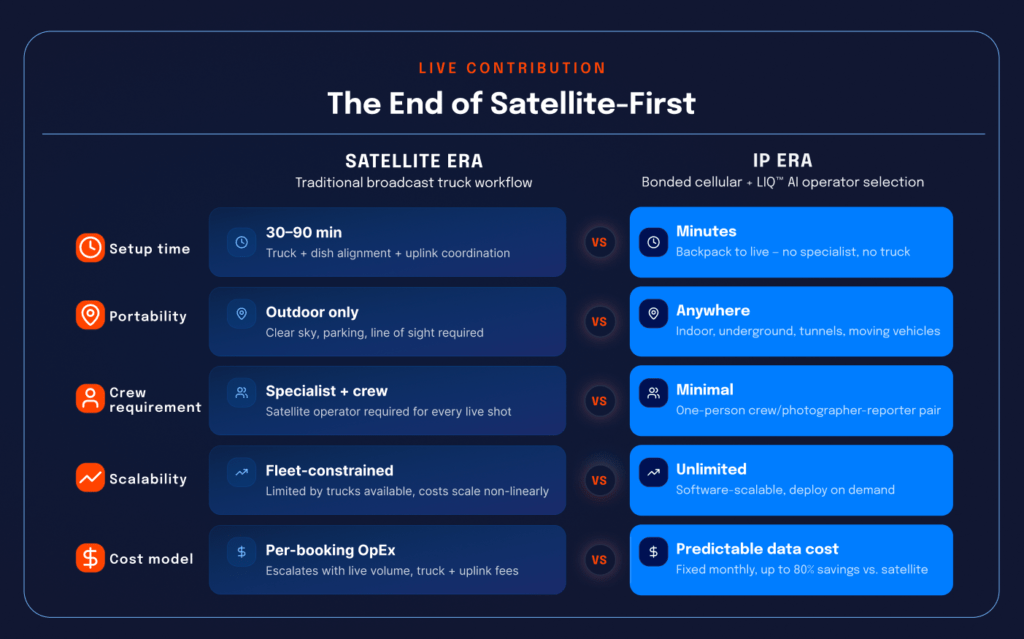
- Cost at volume. Per-booking satellite economics made sense when live hits were relatively rare. As live volume increases across all platforms, the cumulative cost becomes a significant operational factor.
- Availability and geography. Satellite trucks and flyaway kits are not always where you need them when news breaks. Fleet scheduling and transit time can delay time-to-air by hours.
- Access constraints. Trucks require outdoor positioning, clear sky, and sufficient parking. Indoor venues, underground locations, tunnels, dense urban canyons, and moving vehicles all present practical limitations.
- Setup overhead. Deployment, positioning, dish alignment, and coordination with uplink providers add multiple steps before you are live. In many cases, that sequence costs time you may not have.
- Staffing model mismatch. Many routine live hits no longer justify a dedicated truck or satellite operator. Today’s newsrooms run lean – and the contribution workflow needs to match.
- Scalability limits. Satellite handles planned events well but scaling to simultaneous live shots across multiple locations strains fleet availability and drives costs non-linearly.
- Weather vulnerability. Heavy rain and adverse atmospheric conditions can degrade signal quality on satellite uplinks – often at the exact moments when coverage is most critical.
None of these friction points are new. What changed is that IP-based alternatives matured to the point where operational teams no longer need to accept those trade-offs by default.
What Does “Broadcast-Grade Over IP” Actually Mean?
This is the question broadcast engineers ask when IP contribution first gets proposed: reliable compared to what? The internet is best effort by design. Public cellular networks are built for consumer downlink. Neither was built for the continuous, low-latency, uninterrupted uplink that live broadcast requires.
Broadcast-grade over IP means the live feed stays on-air through real-world network fluctuations – brief drops, congestion spikes, carrier handoffs – with behavior that is predictable, not just “it usually works.” What makes that possible is a transport protocol that is video-aware: when a path degrades, the system signals the encoder directly and adapts before the viewer sees anything. Performance stays consistent across days and locations, not just on a good network day. That combination – resilience plus repeatability – is what broadcast-grade IP actually means in practice.
What is IP Bonding, and Why Did it Become the Default Architecture?
IP bonding is the core architecture that makes broadcast-grade contribution repeatable in the field. Rather than relying on a single connection, bonding aggregates multiple independent uplink paths – cellular links from different carriers, wired LAN or WiFi at fixed positions, LEO satellite for remote venues, private 5G at high-stakes events – into one combined, managed contribution path. If any single path degrades or drops, the others carry the load. The principle is simple: the more independently the paths can fail, the more reliably the feed survives.
The LiveU Reliable Transport (LRT™) protocol sits at the heart of this approach, managing packet ordering, dynamic error correction, and adaptive bitrate across all active paths. The practical effect: a single carrier congestion event, a dropped modem, or a last-mile failure no longer causes an outage. The stream adapts across the remaining paths and recovers without any intervention.
That resilience by design is what separates field IP contribution from consumer-grade streaming – and why bonded IP became the operational default for news and sports field units worldwide.
For a detailed guide to building field workflows that hold under pressure in high-density environments – including pre-flight procedures, fallback profiles, and venue-specific patterns – see Crowd-Proofing Live Contribution at Stadiums and Festivals.
Why IP Contribution Now Works at Scale
Enabling Technologies – and One Invention That Changed the Equation
Engineers who evaluated bonded cellular in the 4G era often found it adequate for routine hits but inconsistent in the hardest environments: dense urban congestion, remote locations with marginal coverage, high-stakes events where a second’s dropout is visible. Several things have changed since then – across the industry and at LiveU.
5G coverage and uplink performance
Expanded 5G availability, particularly in mid-band spectrum, meaningfully improved uplink throughput and consistency in urban and suburban environments. 5G’s higher capacity helps at high-demand events where 4G sectors were routinely congested.
Smarter encoding and adaptive transport
Modern field encoders operate at considerably higher efficiency than earlier generations. HEVC (H.265) delivers roughly twice the video quality of H.264 at the same bitrates – a meaningful improvement for bonded cellular paths where every megabit counts.
LEO satellite as a bonded path
Low Earth orbit satellite services like Starlink have added a genuinely new option for IP field contribution. In rural locations, remote venues, or areas where terrestrial cellular infrastructure is limited, LEO provides a high-bandwidth uplink path with acceptable latency for live broadcast. The operational insight – validated across multiple major deployments including LiveU-Starlink integrations at remote sporting events – is that LEO works best as one path within a bonded mix, not as the sole uplink. Combined with multi-carrier cellular, it provides a resilient contribution workflow for the locations that used to require a satellite truck by default.
LiveU IQ (LIQ™): AI-driven cellular operator selection for live broadcast
The improvements above are industry wide. They raised the floor for everyone. LIQ is something different: a technology LiveU invented, as disruptive as IP bonding was twenty years ago.
Standard IP bonding works from a fixed, pre-selected operator set – robust and proven, but with a ceiling: when local network conditions shift rapidly, the system redistributes bandwidth away from degrading links, but the overall bitrate drops because there is no mechanism to replace a poor-performing carrier with a better one in the moment.
LIQ builds on LiveU’s bonding architecture (LRT™), adding an AI-driven operator-selection layer. It continuously analyzes network performance using live data and historical transmission patterns from millions of sessions. Combined with switchable eSIM connectivity, it replaces a degrading carrier entirely by switching to a better-performing operator for the specific location and moment.
Here is what that adds in practice:
| Standard IP Bonding | IP Bonding (LRT) + LiveU IQ (LIQ™) | |
|---|---|---|
| Carrier selection | Fixed, pre-configured SIM set | Dynamic – switches automatically via eSIM |
| Network intelligence | Adapts bitrate across existing carriers | Also analyses live data + historical patterns from millions of sessions to select the best-performing operators |
| Response to congestion | Redistributes bandwidth away from degrading links; overall bitrate drops | Replaces the degrading carrier by switching to a better-performing operator via eSIM |
| Best environment | Low-to-moderate network congestion | Dense crowds, remote terrain, unpredictable or unknown conditions |
| Operator pool | Limited to installed SIMs | Selects best-performing carrier for the specific location and moment |
That capability matters most in the environments that kept satellite trucks in service long after IP became the default everywhere else: the congested stadium, the remote mountain venue, the breaking news position where conditions are unknown until you arrive. LIQ was built specifically for those scenarios.
LiveU in the Field: IP Contribution Under Pressure
Here are two examples which illustrate what broadcast-grade IP contribution looks like when the conditions are hardest.
LU900Q at IRONMAN Texas 2026: LIQ in the hardest conditions a live production can face
BCC Live deployed the LU900Q to cover the 2026 IRONMAN Texas North American Championship – a 10-hour live triathlon broadcast across terrain designed to break cellular signals: tunnels, underpasses, heavy tree cover, motorcycles at 30mph, drones. LIQ switched carriers automatically before the feed degraded – the kind of environment where standard bonding runs out of options.
Tabcorp – Sky Racing: 80% cost reduction achieved by eliminating satellite trucks across eight venues
Sky Racing, the world’s largest aggregator and distributor of horse racing content, covers over 160,000 live races per year across 150 channels. When it moved to an IP-based workflow across eight Queensland racetracks – managed from a central production hub in Brisbane – it eliminated SNG and OB trucks entirely. At its most remote locations, the switch to LiveU reduced operational costs by almost 80%.
IP Won. LIQ Removes What’s Left.
The satellite-to-IP transition is not a trend still in progress. It is settled.
What remains is the boundary question. Bonded IP covers the vast majority of scenarios. LIQ – the world’s first AI-driven cellular operator selection – is specifically built for the rest: the congested venue, the remote mountain, the breaking news position where conditions are unknown until you arrive.
Twenty years ago, LiveU invented IP bonding and fundamentally changed how live production works in the field. LIQ addresses the remaining gap with the same underlying logic: replacing a workflow dependency – in this case, the satellite fallback – by making IP contribution viable where it previously wasn’t.
FAQs
IP contribution is the transmission of a live video signal from the field to a broadcast facility or cloud platform over an internet protocol network, rather than via dedicated satellite or microwave links. In practical terms, this typically means using cellular networks, wired internet, or a combination of both as the transport path, often with bonding technology that aggregates multiple connections for reliability.
Standard cellular streaming uses a single mobile data connection. If that connection degrades or drops, so does the video feed. IP bonding combines multiple independent cellular connections – from different carriers, on different frequency bands – into one managed contribution path. Purpose-built broadcast protocols like LRT™ (LiveU Reliable Transport) handle packet ordering, error correction, and adaptive bitrate across all active paths simultaneously, keeping the feed stable when individual connections fluctuate.
LiveU IQ (LIQ™) is an AI-driven connectivity layer that extends standard bonded cellular with dynamic, real-time operator selection. Where standard bonding works with a fixed set of pre-selected carrier SIMs, LIQ continuously analyzes network performance using live data and historical transmission patterns from millions of sessions, then automatically switches eSIM connections to the best-performing operators for the specific location and moment. This makes IP contribution viable in environments – dense crowds, remote terrain, unpredictable cellular conditions – that previously required satellite as the default fallback. The LU900Q is LiveU’s first field unit with native LIQ built in.
Satellite contribution remains justified for remote locations where terrestrial cellular infrastructure is absent or unreliable; international deployments where ground network quality is uncertain; scenarios requiring completely independent path redundancy alongside IP; and specific major events where guaranteed, dedicated uplink capacity is a production requirement. The practical shift is that this list is narrower than it was five years ago, as bonded IP – and increasingly LIQ-enabled IP contribution – solves more of the scenarios that previously defaulted to satellite.
Learn more about intelligent IP contribution: LiveU IQ | LU900Q