

America 250 is Coming. Is Your Public Safety Video Infrastructure Ready?
Key Takeaway
The Stakes of a Once-in-a-Generation Event
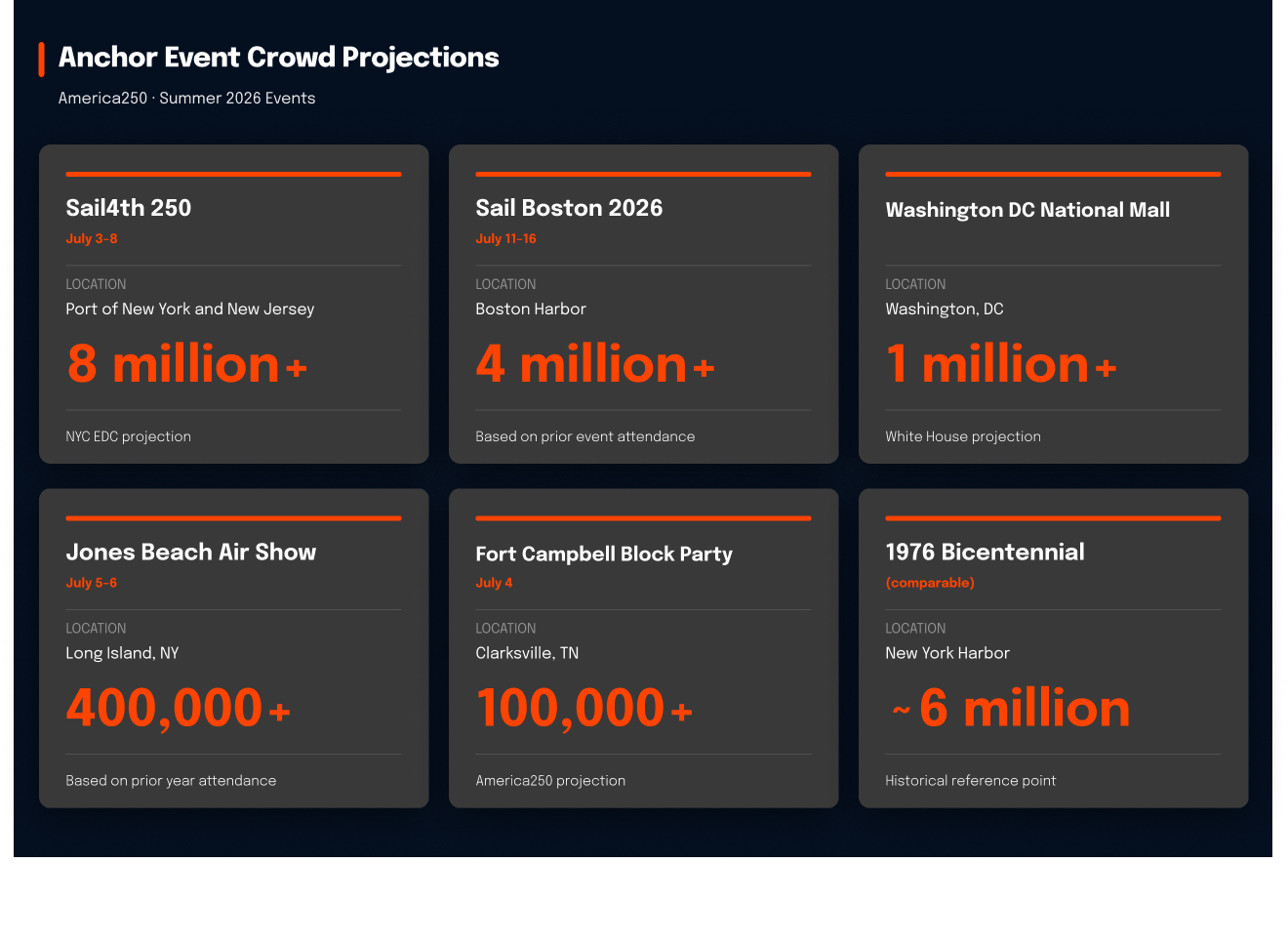
NYC Task Force Commissioner Zach Iscol compared 2026 event crowds to “have the equivalent of nine Super Bowls happening.” For public safety agencies, that’s not a headline. It’s a planning challenge for police commanders due to the scale, simultaneity, and geographic spread of events nationwide.
Large crowds are inherently unpredictable. What separates a well-managed event from a crisis is often not the number of officers on the ground. It is what the people making decisions can see, and how quickly they can act on it.
For decades, agencies have relied on fixed camera infrastructure: mounted systems, static overviews, and footage often reviewed after the fact. But today’s events move faster, cover more ground and require coordination that static systems were not designed to support.
With America 250 on the horizon, the window to plan and deploy the right approach is now.
The Crowd Control Problem Has Changed
Public safety planning for large events has always been complex. But the nature of that complexity has shifted in ways that traditional operational models were not built to handle. Real-time situational awareness is no longer a capability advantage; it is a foundational requirement, one that directly improves officer safety, accelerates decision-making, reduces agency liability, and strengthens public accountability during high-profile events.
Modern large-scale events rarely unfold in a single, contained space. Incident commanders are no longer managing one crowd, but multiple crowd zones with different density, movement patterns, and risk profiles. According to Research and Markets, the U.S. crowd management and event security market is projected to grow nearly 20% annually, driven by rapid adoption of intelligent crowd monitoring technologies including drone surveillance and AI-enabled analytics.
At the same time, the speed at which situations develop has accelerated. A single incident in one corner of an event footprint can trigger cascading effects across the entire operational area before a radio call has been completed.
Fixed camera infrastructure has a role, but it was designed for a more static world. Predetermined angles, line-of-sight restrictions, and fixed network dependencies leave critical gaps when crowds shift, incidents move, or conditions change rapidly. Commanders need mobile, adaptable, and real-time visual intelligence, not viewpoints locked to where cameras happened to be installed. LiveU enables agencies to unify all of it: existing fixed infrastructure, temporary surveillance towers, and mobile ad-hoc assets like drones, into a single coherent operational picture.
| Capability | Fixed camera infrastructure | Real-time mobile video |
|---|---|---|
| Coverage | Limited to installed locations | Moves with officers, vehicles, drones, and incidents |
| Deployment speed | Requires planning, permits, installation, power, and network access | Can be deployed dynamically as event conditions change |
| Best use | Monitoring known high-risk locations | Following changing crowd conditions and mobile incidents |
| Limitation | Cannot follow activity outside the camera’s field of view | Requires reliable transmission infrastructure |
| Public safety value | Provides static visibility | Provides live operational awareness |
Agencies are increasingly recognizing that comprehensive situational awareness at a large, dynamic event requires a different approach that is built around mobility, redundancy, and the ability to put eyes exactly where an incident is unfolding in real time.
That shift is what is driving adoption of mobile live video across law enforcement, emergency management, and public safety operations. And it is arriving at a moment when the operational demands on those agencies are about to reach a scale most have never encountered before.
What Does «Live Eyes on Every Corner» Actually Mean?
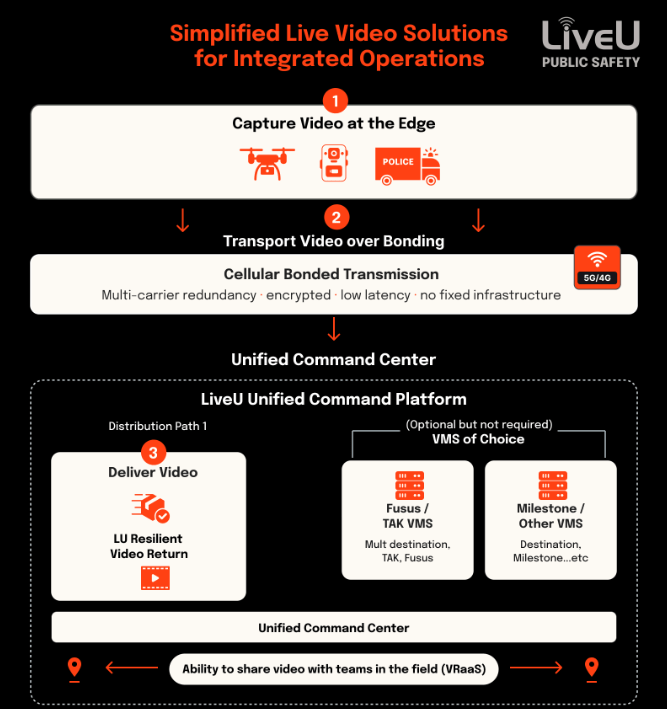
For a commander in an operations center, “live eyes on every corner” means dynamic, deployable visibility that follows the situation as it develops – not a selection of fixed angles chosen weeks before the event. That means live feeds from mobile ground units, and aerial assets like drones and helicopters, all viewable in real time from a single unified operational picture.
Previous national commemorations have required coordination across dozens of local, state, and federal agencies, creating a useful precedent for the multi-agency demands America 250 may place on public safety teams.
Use Cases for America 250 Public Safety Operations
America 250 events will vary by city, venue, and scale, but many agencies will face a common set of live video use cases.
Ingress and egress management
Live video monitoring of entry and exit flows allows commanders to identify bottlenecks, manage crowd pressure at access points, and coordinate evacuation choreography in real time before conditions deteriorate.
Parade and street corridor monitoring
Long, linear routes bordered by crowds on both sides are poorly served by fixed cameras. Mobile units’ transmission allows supervisors to maintain continuous visibility along the full route and identify pressure points before they escalate.
Waterfront and open-air venue management
Open geography defeats perimeter planning. Aerial assets combined with mobile ground units give commanders a composite picture across terrain that fixed infrastructure cannot cover.
CBRNE threat defense
Chemical, biological, radiological, nuclear and explosives (CBRNE) threats require the fastest possible detection and coordinated multi-agency response. Real-time video from aerial and ground assets gives commanders visibility to confirm threats and direct containment before conditions escalate.
Multi-agency coordination
America 250 events will routinely involve municipal, state, federal, and emergency services agencies operating within the same footprint. Shared live video feeds create a common operating picture that accelerates joint decision-making across organizational boundaries.
Medical and emergency response
High-density events present significant logistical challenges for medical response teams. Live video gives on-the-ground medical personnel and their supervisors shared situational awareness across large, crowd-separated staging areas, enabling faster deployment decisions without relying on radio descriptions alone.
Entry screening and search operations
Real-time visibility of screening lanes, queue conditions, and crowd flow allows commanders to identify bottlenecks early, scale capacity ahead of surges, and maintain consistent, documented security procedures across multiple entry points.
Accountability and documentation
High-visibility national events carry significant public and legal scrutiny. Live transmission creates a real-time record that supports supervisory oversight, after-action review, and accountability.
Why Cellular Bonding Matters for Public Safety
Of all the technical considerations in deploying live video at large public events, signal reliability may be the least understood.
When tens of thousands of people converge in the same place, every smartphone attempting to stream, post, and communicate competes for bandwidth on the same local cell towers. The result is network congestion – and it happens at exactly the kinds of events public safety agencies are responsible for managing. For cameras transmitting live footage from the center of a crowd of 50,000 people, that degradation is not a technical inconvenience. It is an operational blind spot.
Most devices rely on one cellular network at a time. Bonded cellular combines multiple carrier networks – including WiFi, Ethernet, and satellite – into one resilient transmission path, so if one connection degrades under crowd-driven congestion, others compensate. LiveU’s Reliable Transport (LRT™) protocol adds forward error correction and adaptive bitrate management to maintain a stable feed even as network conditions fluctuate. This is “automated PACE (Primary, Alternate, Contingency, Emergency),» real-time load-balancing to ensure the video and data can reach decision-makers.
LiveU’s bonded cellular encoders – including the LU-REQON1 – are purpose-built for exactly these environments. Used at major sporting events and national operations, they bond multiple carrier networks into a single resilient transmission path, maintaining live video even as commercial networks begin to fail individually around them.
What Should Public Safety Agencies Plan Before America 250?
The window to act is narrower than most agencies realize. America 250 will generate hundreds of simultaneous events across every state, each with its own lead agency, its own footprint, and its own operational requirements. There is no single command coordinating the full picture. Every jurisdiction is, in effect, planning its own event, often without the benefit of the multi-year runway that federal agencies work with.
Agencies cannot simply staff their way to comprehensive situational awareness. Technology has to carry more of the load. For live video specifically, agencies should work through the following planning questions now:
| Planning area | Question agencies should answer |
|---|---|
| Coverage mapping | Where are the gaps in current fixed-camera coverage? |
| Asset inventory | Which devices can transmit live video? |
| Command center integration | Can multiple feeds be viewed and shared securely? |
| Workflow and training | Who monitors feeds, who acts on them, and how are decisions escalated? |
| Vendor lead times | How long will procurement, testing, integration, and training take? |
Visibility Is a Public Safety Decision
Large-scale public events do not fail because agencies lack commitment. They fail when decision-makers cannot see what is happening quickly enough to act. America 250 will test that visibility across hundreds of simultaneous events, spanning every jurisdiction, every crowd size, and every operational complexity – all at the same time. Fixed infrastructure, single-network transmission, and traditional command models were not built for that.
LiveU works with public safety agencies at every stage of this planning process – from coverage assessments to integration with existing command platforms. Real-time mobile video, cellular bonding, and unified multi-feed command visibility are not future capabilities. They are available now, and the agencies that deploy them thoughtfully before July 4, 2026, will be in a fundamentally different operational position than those that do not. Visibility on this scale is not just a technical feature. It is a public safety decision.
FAQs
Fixed video infrastructure monitors pre-installed locations. Mobile live video can move with officers, vehicles, drones, and incidents, giving command teams visibility beyond static camera coverage.
Agencies should begin planning as early as possible because major event security guidance often recommends starting 12 to 18 months in advance, and procurement, testing, integration, and training all require lead time.
Agencies should ask whether the system supports multi-carrier bonding, encrypted transmission, command center integration, access controls, adaptive bitrate management, and multi-agency feed sharing.
Bonded cellular combines multiple carrier networks – including Wi—Fi, Ethernet, and satellite – into one resilient transmission path, so if one connection degrades under crowd-driven congestion, others compensate. LiveU’s LRT protocol applies additional techniques including forward error correction, adaptive bitrate management, and packet duplication to maintain a stable feed even as network conditions fluctuate.
Yes – and this is one of LiveU’s strongest value propositions. LiveU is agnostic to both the sensor and the destination. Whether agencies are running Fusus, TAK, Milestone, or any other VMS or real-time crime center platform, LiveU acts as the connective tissue that links distributed sensors – fixed cameras, UAV fleets, mobile units – into a unified, shareable live video feed for command.
Agencies don’t need to replace existing infrastructure. More importantly, LiveU enables disparate agencies running entirely different tools to interoperate – sharing live video across jurisdictions at the speed and tempo that mutual aid demands, even under the strain of a major incident. When a multi-agency response is activated, LiveU bridges the gaps between systems that were never designed to talk to each other.
- Sail4th 250 New York/New Jersey’s Spectacular Plans to Mark America’s 250th Birthday | Sail4th 250
- Sail Boston Everything you need to know about Sail Boston 2026
- Washington DC Freedom 250 – The White House
- Jones Beach — Jones Beach FourLeaf Air Show moving to Fourth of July weekend for 2026 to honor US nation’s 250th birthday — ABC7 New York
- For Campbell 100-Day Countdown to the Fourth of July: America250 Reveals First Five Host Cities for July 3-4 Block Parties and Launches National Give-Back Effort — America250
- 1976 Bicentennial — Operation Sail 1976: How New York City Came Together in a Time of Crisis — The Gotham Center for New York City History