



Compliance Logging Is Not Enough: The Case for Proactive QA Monitoring
Summary
What Is the Traditional Role of Compliance Logging?
For decades, compliance logging has been a mandatory requirement for broadcasters. Record the feed, store it securely, and retrieve it when needed.
It remains essential. But in today’s broadcast environment, it is no longer sufficient.
The reality is simple: recording a problem is not the same as preventing it.
And that’s where proactive QA monitoring becomes critical.
Historically, compliance logging was designed as a defensive mechanism:
- Record every channel
- Retain content for a defined period
- Retrieve evidence upon request
- Protect the organization from regulatory disputes
This approach worked in a linear broadcast world with fewer channels and stable infrastructures. But today’s environment is more complex, with hybrid SDI/IP infrastructures, cloud playout, stricter oversight, and higher audience expectations.
The Gap Between Compliance Logging and QA Monitoring
Many organizations still separate compliance logging systems, technical monitoring tools, and multiviewer environments. When these systems operate independently, blind spots emerge.
Common real-world scenarios include loudness violations without alerts, black frames going unnoticed, audio silence before detection, and metadata failures impacting obligations.
Compliance logging proves what happened. Proactive QA monitoring helps ensure it doesn’t happen in the first place.
Compliance Logging vs. Proactive QA Monitoring: What’s the Difference
| Capability | Compliance logging | Proactive QA monitoring |
|---|---|---|
| Primary purpose | Archive & evidence retention | Real-time fault detection |
| Loudness verification | Post-event review | Continuous monitoring aligned with ITU-R BS.1770 |
| Black frame detection | Manual review | Automated real-time detection |
| Audio silence alerts | Not proactive | Configurable real-time thresholds |
| Metadata/SCTE verification | Limited visibility | Active integrity monitoring |
| Incident prevention | No | Yes |
| Mean time to detect (MTTD) | Potentially hours or days | Seconds |
Compliance logging documents issues after they occur. Proactive QA monitoring identifies and alerts on them in real time.
Where Modern Broadcast Workflows Actually Break
In today’s hybrid SDI/IP/2110 and OTT environments, most quality failures are not catastrophic outages – they are brief, subtle faults that are easy to miss but operationally significant.
Typical examples include:
- Loudness drift during ad insertion transitions
- 2–5 second black/blue screen events during router switching or encoder failover
- Audio channel mapping errors after playout configuration changes
- Missing or malformed SCTE markers affecting ad compliance
- Short signal degradation events in IP transport environments
- Missing CC/DVB-Subtitles, Audio tracks, etc
These incidents may last only seconds – too short for manual monitoring to reliably detect – yet long enough to violate internal SLAs, contractual commitments, or regulatory thresholds.
Compliance logs capture them after the fact.
Proactive QA monitoring detects them as they happen.
Why Reactive Monitoring Is No Longer Enough
Today’s risks include regulatory penalties, advertising disputes, political compliance violations, brand reputation damage, and loss of audience trust.
Reactive monitoring discovers issues only after complaints arise. In complex multi-channel environments, relying on post-event review significantly increases detection latency and operational exposure.
Proactive QA monitoring shifts the model from “find the issue later” to “detect and resolve immediately.”
What Does Proactive QA Monitoring Include?
Proactive QA monitoring integrates real-time technical analysis directly into the compliance environment:
- Continuous loudness measurement aligned with standards such as ITU-R BS.1770 and regional regulatory requirements
- Black or blue screen, frozen video detection, color bars, etc
- Audio silence monitoring
- Signal loss and degradation alerts
- Metadata verification: CC, DVB-Subtitles, SCTE, audio tracks, etc
- Configurable, priority-based notifications
Instead of a passive archive, the system becomes an active guardian.
What Is the Operational Impact of Real-Time Detection?
The difference between logging and proactive QA is not only technical – it is operational.
In a typical monitoring center, operators oversee dozens – sometimes hundreds – of feeds simultaneously. Without automated real-time alerts, subtle faults may go unnoticed until a viewer complaint or regulatory inquiry surfaces.
Proactive QA monitoring reduces Mean Time to Detect (MTTD) from hours to seconds. Earlier detection enables faster corrective action, minimizes SLA breaches, and prevents minor technical issues from escalating into reputational events.
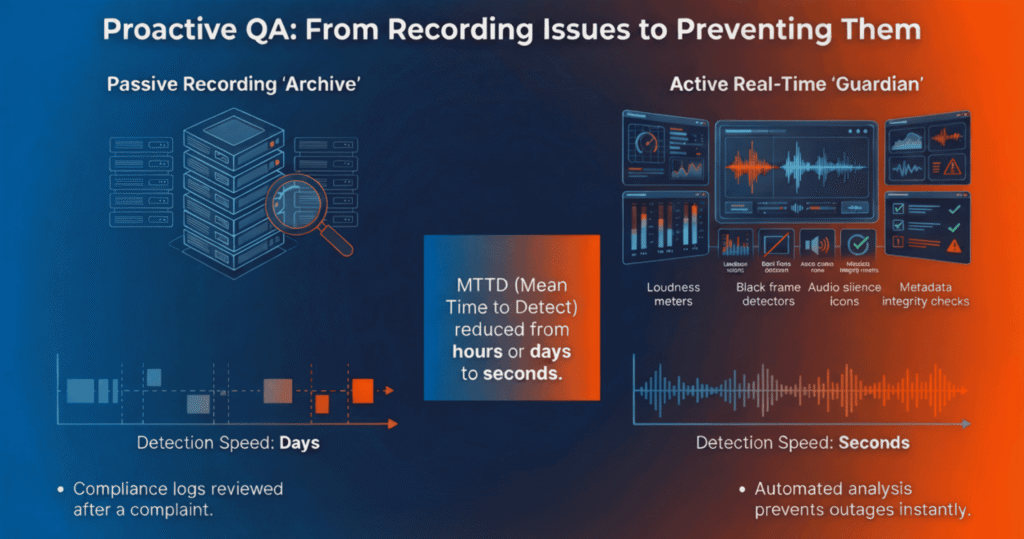
Shifting from “finding the issue later” to “detecting and resolving immediately” protects SLAs and brand reputation
Equally important, configurable thresholds and prioritized alerting help prevent alert fatigue – ensuring operators focus only on actionable incidents rather than constant noise.
This shift transforms monitoring from reactive review to active quality control.
The Operational Advantage of Integration
When QA monitoring and compliance logging operate within a unified platform, organizations gain:
- Faster incident response
- Clear accountability with timestamped audit trails
- Reduced system complexity
- Improved cross-team collaboration
- Stronger regulatory protection
As channel counts scale across OTT, FAST, regional variants, and multi-platform distribution, unified monitoring becomes not just efficient – but operationally necessary.
Conclusion
In today’s broadcast environment, compliance logging alone is not enough.
Organizations that adopt proactive QA monitoring will reduce risk, strengthen operational control, and build long-term trust with regulators and audiences alike.
In increasingly distributed and IP-driven broadcast ecosystems, real-time QA monitoring is evolving from a technical enhancement into a core operational requirement.
Actus Digital’s intelligent monitoring platform brings compliance logging, real-time QA detection, and multiviewer capabilities together within a unified environment – helping broadcasters move from reactive recording to proactive quality control in modern hybrid and IP-based workflows