



Supporting the biggest moments of the World Football Championship games in the US, Canada, and Mexico
Summary
How is the 2026 World Football Championship changing live broadcast workflows?
The World Football Championship is a landmark event in the evolution of sports media, representing the most logistically complex and technologically advanced broadcast operation in the history of the sport. The tournament is set to be the biggest event that LiveU has enabled to date.
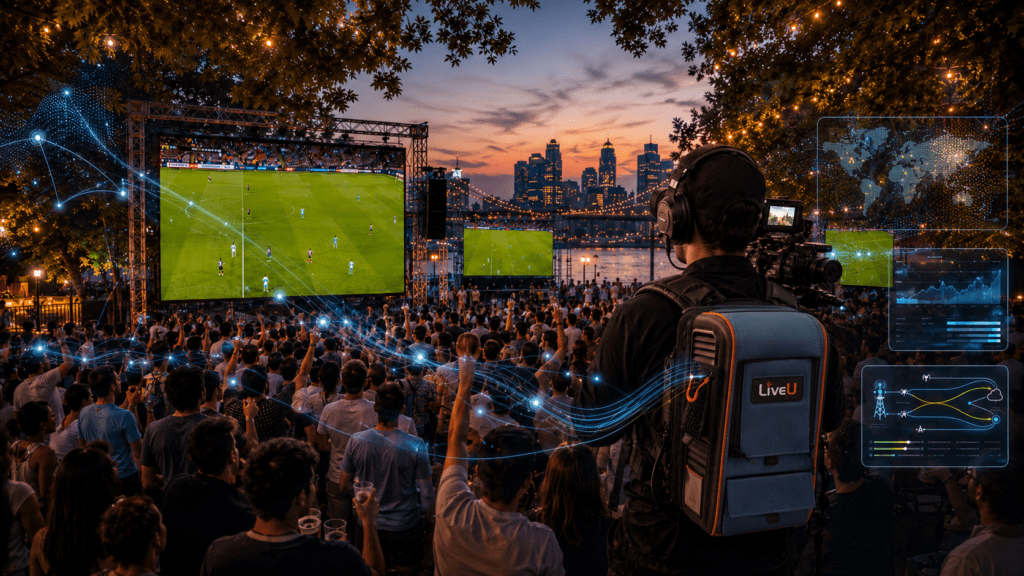
As the tournament approaches, several key factors define its significance:
1. Unprecedented Scale and Complexity
The 2026 edition is the first to feature 48 teams and 104 matches – a massive increase from the 64-match format of previous years.
Broadcasters will manage a rigorous schedule of 27 consecutive days of matches. In the initial weeks, the volume of games played will equal that of an entire previous tournament before the first rest day.
Covering 16 host cities across three countries (U.S., Canada, and Mexico) creates a massive “multi-venue coordination” challenge. The Broadcast Auxiliary Service (BAS) has been deployed within a 5-kilometer radius of each stadium to manage frequency coordination and ensure signal stability.
2. Modern Media Ecosystem Integration
This year’s tournament is serving as a definitive showcase for the shift from linear television to a multi-platform viewing experience.
For the first time, organizers have designated TikTok and YouTube as preferred platforms. Broadcasters can stream full select matches on YouTube and the first 10 minutes of every match, while TikTok will host a dedicated video content hub.
Major rights holders are splitting content between primetime broadcasting and streaming platforms for digital-first audiences.
Platforms like DAZN and Telemundo Deportes Ahora (a FAST channel) are providing shoulder programming that begins an hour before the first kick-off and continues long after the final whistle.
3. Enter the Independent Creators
More and more independent creators and IRL streamers will be covering the event on their channels. Some have even secured positions as official field reporters for larger media organizations. (Stay tuned for a separate case study on that!)
4. Localization and Global Reach Challenges
Despite its global scale, the matches are being touted as the most local tournament yet.
Networks are leveraging O&O stations to capture community-level stories across the US, tailoring broadcasts to reflect the specific fan bases and heritage of viewers from different countries.
5. Technical Innovations
Broadcasters are moving toward an accelerated IP (Internet Protocol) strategy. This allows for large-scale, simultaneous remote productions across multiple sites, reducing the need for massive on-site crews while maintaining high-fidelity 4K broadcasts. This innovation is essential for managing the sheer volume of 104 matches without overwhelming infrastructure.

What is LiveU’s role at the 2026 World Football Championship?
This is a watershed moment for LiveU. Deploying its full EcoSystem – from the high-performance field units to the Nexus gateway, Record (LiveU Ingest), and our cloud-native infrastructure – demonstrates that, with cellular bonding at our core, we are a comprehensive live video workflow provider – backed by award-winning products and support.
Here is how we view the strategic importance and the future signal of this milestone:
1. The Strategic Significance
Bringing the complete stack to a single, global stage like the World Cup isn’t just about technical capability; it’s about removing friction.
- Unified Orchestration: By controlling the entire chain – from the moment light hits the lens to the final distribution point – we eliminate the finger-pointing that can happen with multi-vendor setups.
- Unmatched Connectivity: LiveU’s new LU900Q intelligent production field unit, as well as an army of LU800 units, will have LIQ inside (in the US) – continuously monitoring all available connections and switching to the strongest path in real time, before degraded signal reaches your feed.
- At the Winter Games, broadcasters relied on LIQ to dynamically manage connectivity in some of the most demanding live production environments – from crowded arenas to remote mountain venues. Around 60% of supported sessions were transmitted using LIQ, achieving over 36% higher average bitrates and enabling consistent 4K and HDR coverage, at scale. Broadcasters were able to confidently rely on IP contribution as a primary workflow, supporting both traditional broadcast and digital-first distribution strategies.
- Efficiency at Scale: The integration of LiveU Record allows broadcasters to instantly turn live feeds into searchable, editable assets in the cloud while the match is still in progress. This collapses the time between action and audience.
- The Nexus Factor: Our Nexus gateway serves as the bridge between traditional SDI and modern IP-based workflows (like ST 2110), allowing customers to modernize their operations at their own pace without discarding legacy equipment.
2. The Strategic Thinking: “Reliability as a Service”
The core philosophy behind the full offering is to remove risk within the production.
- Predictability: In the high-pressure environment “good enough” doesn’t fly. Our complete stack ensures that the proprietary LRT™ (LiveU Reliable Transport) protocol is optimized at every turn – from the field unit to the cloud and back to the studio.
- Cost-Effective Complexity: We are enabling high-end, multi-camera remote production (REMI) that was previously only possible with a fleet of satellite trucks. This democratizes top-tier production quality for a wider range of rightsholders.
3. Signals for the Future
This deployment is a clear indicator of LiveU’s trajectory:
- Cloud-Native Everything: We are moving toward a future where the hardware in the field is simply the on-ramp to a hybrid and software-defined production environment in the cloud.
- Convergence of Industries: The inclusion of public safety and specialized creators in this ecosystem signals that LiveU is no longer just for news and sports. We are the connectivity layer for any organization that requires mission-critical video.
- AI and Automation: Moving the full stack into the cloud prepares us for the next leap: using AI to automate highlights, monitor signal health, and optimize bandwidth in real-time, making live production more “intelligent” rather than just “connected.”
The Bottom Line
This isn’t just about supporting a tournament. It’s a proof of concept for the future of live storytelling. It signals that LiveU is ready to own the entire live video lifecycle, providing a level of agility and reliability that traditional hardware-heavy models simply cannot match.
FAQs
The tournament is accelerating the move toward IP sports workflows, remote sports production, and cloud-based sports broadcasting. Instead of sending large production teams and trucks to every venue to cover ancillary content, broadcasters can use IP contribution, cellular bonding, cloud production tools, and remote integration models to manage live feeds from multiple locations. This helps production teams cover more ground, create more digital content, and support traditional broadcasts, streaming/OTT platforms, and social media.This isn’t just about supporting a tournament. It’s a proof of concept for the future of live storytelling. It signals that LiveU is ready to own the entire live video lifecycle, providing a level of agility and reliability that traditional hardware-heavy models simply cannot match.
LiveU provides a full live video workflow, from field contribution to cloud-based production tools and broadcast facility integration. For this tournament, LiveU’s EcoSystem provides a complete solution that help broadcasters capture, transmit, manage, record, and distribute live sports content across multiple venues and platforms.
The LiveU EcoSystem is a connected set of tools for live video production and distribution. It includes field units such as the LU900Q and LU800, intelligent connectivity tools such as LiveU IQ, transport technology through LiveU Reliable Transport, cloud recording through LiveU Record, professional ingest through LiveU Ingest, and workflow bridging through Nexus. For sports production teams, this means fewer disconnected tools and a clearer path from camera to cloud, studio, and audience.
TLiveU IQ monitors available network connections and helps select the strongest path in real time. In crowded stadiums and busy host cities, network conditions can shift from one moment to the next. LiveU IQ helps manage those changes automatically before they affect the live feed. According to a recent blog post, broadcasters using LiveU IQ at the Winter Games achieved over 36% higher average bitrates, with around 60% of supported sessions transmitted using LIQ. That performance gives broadcasters more confidence when using IP contribution for premium live sports coverage including 4K and HDR workflows.
Nexus acts as a bridge between traditional broadcast infrastructure and IP-based workflows. Many broadcasters still use SDI equipment, while more production workflows are moving toward IP formats such as ST 2110. Nexus helps teams connect both worlds, so they can modernize at their own pace instead of replacing existing systems all at once. For the 2026 World Football Championship, that flexibility matters. Crews need modern IP workflows without disrupting the infrastructure they know and trust.