




Live Sports Production in 2026: Scaling with Cloud, IP & Remote Workflows
Summary
In 2026, live sports will reach an unprecedented scale. The World Football Championship will span three nations and 16 cities, the Winter Games will stretch across the Italian Alps, and the American Football Championship will again attract huge audiences. Countless regional tournaments will also fill the calendar around the world.
For broadcasters, this isn’t just a busy year – it puts every aspect of live production to the test. At the same time, the industry faces a paradox: soaring demand, rising rights fees, shrinking budgets, and audiences who expect every moment on every screen instantly. The question is no longer whether live production can scale, but how.
To meet the expectations of today’s sports audiences, IP-based contribution, remote production (REMI), and cloud-driven workflows are no longer optional. They are becoming the new standard for delivering live sports across multiple platforms and formats.
For production leaders, the shift in viewer expectations and content consumption changes how major events must be planned and executed. Instead of scaling by adding crews, trucks, and travel, the focus moves to scaling workflows – using IP contribution, remote production, and cloud tools to run productions from a centralized control room with minimal on-site crews. This approach allows teams to support multiple venues, formats, and platforms simultaneously without proportional increases in cost or complexity. In 2026, this model moves from competitive advantage to operational necessity.
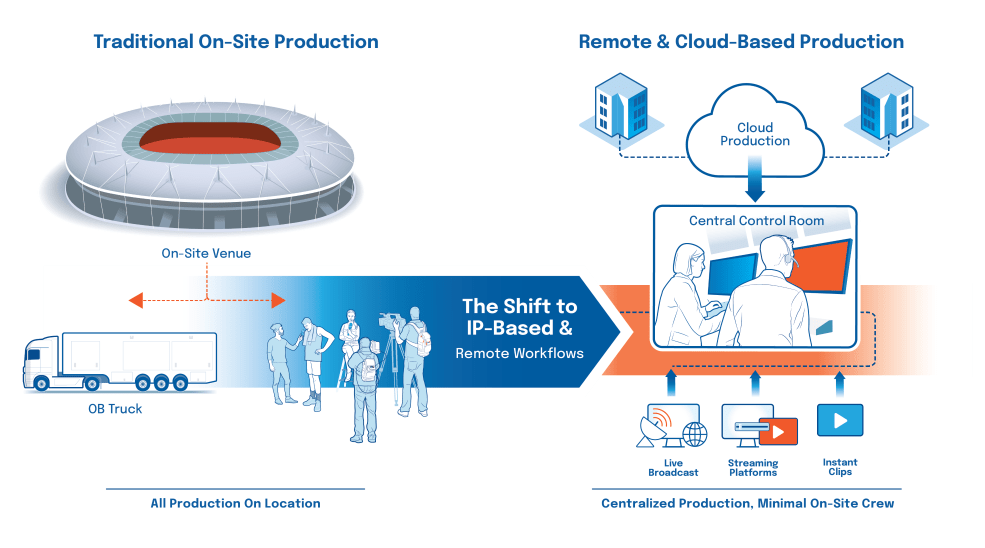
Modern live sports production workflow using cloud and IP
What Is Driving the Shift in Live Sports Production?
The traditional on-site production model is increasingly unable to meet today’s demands. Remote production (REMI), lightweight crews, IP contribution, and cloud workflows have become the new operating standard – enabling higher volume, lower cost, and new creative formats.
This shift didn’t happen suddenly. It evolved as leagues, networks, and digital platforms sought ways to:
- Create more content without expanding budgets
- Reduce travel and on-site operational burden
- Support multiple venues simultaneously
- Increase the speed of highlights, clips, and social-first content to engage Gen Z and younger audiences
- Expand beyond the traditional broadcast window
A Comprehensive Connected Production Model For Global Events
World Football Championship
Covering 16 host cities across three nations demands speed and coordination at a scale the industry has never faced, expecting over five million fans to attend. In 2022, a team of over 2,500 were needed to coordinate the broadcast production with 42 cameras needed per game and several more for fan coverage, team arrivals, and interview coverage before and after the game.
To keep pace, production teams now rely on portable, flexible workflows that allow them to gather content across vast distances without deploying full crews to every location.
Synchronized multi-camera feeds, remote production hubs, and seamless cross-border operations can all be done without sending full crews to every venue. Digital teams can capture vertical, social, and on-the-move content that meets audiences where they are, answering the need for authentic and personalized live content.
Winter Games in Milan–Cortina
Mountain ranges, extreme weather, and distributed venues require resilient, flexible connectivity. A single production hub can manage live feeds from multiple alpine and ice events simultaneously, while remote commentators and editors collaborate entirely in the cloud. With over two billion people watching the previous Winter Games in 2022, the upcoming games in Italy will demand seamless global streaming at unprecedented scale.
The challenge is clear: broadcasters need to provide more creative coverage while operating with fewer on-site resources.
How IP and Cloud Workflows Are Simplifying Live Sports Production
With live IP-video and fully cloud-driven workflows, production teams can now focus on multi-angle storytelling with reduced operational costs.
Production is becoming:
- IP-native rather than hardware-bound
- Cloud-orchestrated rather than on-site dependent
- Software-defined rather than infrastructure-heavy
- Globally collaborative rather than centrally localized
2026 will accelerate this transformation, with AI also expected to play an increasing role in automating end-to-end workflows. The model built here will define the next decade of sports broadcasting: flexible, software-defined, and infinitely scalable with the ability to offer tailored experiences.
IP-native, remote, and cloud-driven production allow events to be produced simultaneously across multiple venues and platforms. Modern sports coverage is no longer confined to a single stadium or broadcast feed; it requires capturing and distributing live video from many locations in real time.
Rights holders no longer need to choose between traditional broadcast and OTT platforms – they can plan for multi-feed, multi-format delivery from the start. Powered by flexible cloud production and scalable IP video workflows, a single live event can now generate everything from a premium broadcast feed to vertical social video, creator-led companion streams, behind-the-scenes content, and localized versions for global audiences. And while viewing habits continue to fragment, major moments like the upcoming Winter Games and World Football Championship prove that the big-screen broadcast work still play a central role, while providing a growing range of complementary digital experiences.
Scaling Sports Production with The LiveU EcoSystem
LiveU’s IP-video EcoSystem brings this model to live by unifying every stage of live production – from contribution and production to distribution. Field teams can capture high-quality live feeds using portable encoders like the multi-cam LU800 and newly introduced LU900Q, while centralized production teams switch, mix, and add commentary remotely using LiveU Studio. LiveU Ingest automatically records live streams in the cloud, making content immediately available for clipping, metadata tagging, and fast turnaround highlights. Content can then be shared in real time across partners, rights holders, and platforms via LiveU Matrix, supporting multi-feed and multi-format delivery at scale.
The industry is ready for what’s next. And 2026 will be the year that proves it.
To see how these workflows are implemented in real-world productions – explore our customer case studies – or contact us to discuss specific production requirements.