




Broadcast in 2026: 3 Key Trends Reshaping the Industry
Summary
As the industry enters a new year, news and broadcast organizations are operating in an environment shaped by speed, accuracy, and public trust. The demand for live, real-time coverage continues to accelerate across mobile and digital platforms. From local newsrooms in North America to national and regional broadcasters across EMEA and APAC, the mandate is intensifying – to deliver fast, trusted, high‑quality live content while managing cost, complexity, and operational risk.
We are finding that broadcasters are aligning around three defining trends that are set to shape decision‑making in the year ahead – digital‑first operations, AI and workflow automation, and continued migration to IP-based production. This year also represents a significant moment for sports broadcasters, with a packed global calendar of major tournaments and international events. For many news organizations, sports coverage will drive peak live viewing, increased digital engagement, and heightened expectations for immersive, uninterrupted live production.
Together, these trends reflect a broader industry shift from incremental change to structural transformation, streamlining production workflows.
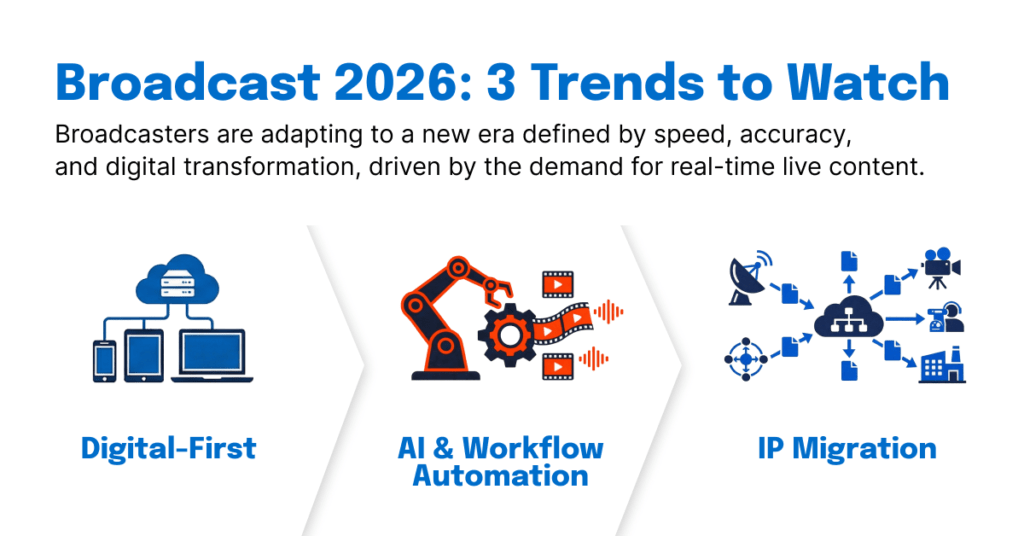
1. Digital-First Becomes a Critical Operating Model Decision
The transition to digital-first is no longer aspirational – it is foundational and increasingly urgent. Digital-first has become an operating-model decision, not merely a publishing strategy, as broadcasters recognize that digital platforms are not extensions of linear operations, but primary destinations for content creation, distribution, and engagement. This shift is especially true for Gen Z and younger audiences, for whom digital, social and mobile platforms are the primary destination for news and content. To keep pace, broadcasters are consolidating production and contribution into unified, IP-native environments to avoid duplicated workflows, fragmented teams, and rising operational costs.
This trend is reshaping how studios operate, how stories are produced, and how content flows across ecosystems. Cloud-based production, IP contribution, and unified digital and IP-based platforms enable organizations to manage live feeds centrally while supporting distributed teams and creator-driven workflows. As the creator economy influences storytelling formats and audience expectations, news organizations are adapting with more flexible, story-centric production models that prioritize speed and accessibility – without compromising accuracy, editorial integrity, or the importance of the stories they tell.
Digital-first organizations are better positioned to scale coverage, experiment with new formats, and meet audiences where they are – maintaining the quality and standards of existing productions without increasing overhead.
2. AI and Workflow Automation as Catalysts for Scalable Live Production
As live production volumes grow, manual workflows are becoming a bottleneck. AI and automation are emerging as critical enablers – helping broadcasters to scale, and do more with the same resources, without increasing operational risk.
Workflow automation now spans the full live production lifecycle: ingesting content, monitoring feeds, booking live productions through scheduling systems, enriching metadata, and applying AI-driven capabilities such as automatic clipping, mixing, transcription and content enhancement. The result is a multi-platform, story-centric workflow, where editorial teams can focus on narrative and context rather than operational coordination.
Orchestration plays a key role in connecting these elements – ensuring that live productions move seamlessly from planning to air across both linear and digital channels. And that’s why we’re breaking down orchestration silos. The LiveU EcoSystem operates across hybrid deployments – including hardware and software, on-prem, SaaS, and private cloud infrastructures – while seamlessly integrating both our own and third-party solutions.
For broadcast leaders, automation is no longer about efficiency alone; it is about enabling scale without sacrificing control or quality.
3. IP Migration, Resiliency, and the End of Satellite Dependency
The industry’s shift to digital and IP-based production continues to accelerate, driven by the need for greater agility, resilience, and cost efficiency. Moving away from satellite-heavy workflows is no longer just a financial decision – it is a strategic operational imperative.
IP contribution combined with cloud-based distribution enables broadcasters to deploy more productions, from more locations, without the complexity and rigidity of traditional infrastructure. LiveU IQ (LIQ™) plays a critical role in this transition, applying AI to use the best available cellular networks for reliable performance in congested environments and remote locations; eSIMs are intelligently switched between operators.
Purpose-built solutions like the new LU900Q field unit, with LIQ and agility built in, extend resilient IP workflows directly into the field and mobile production environments. By delivering consistent, broadcast-quality live video over bonded cellular networks, LU900Q enables crews to operate with confidence – removing the reliance on satellite while maintaining the reliability and increasing the flexibility demanded by news and sports operations. As live coverage expands and production teams are expected to do more with less, IP-based workflows provide the scalability, speed, and operational resilience needed to grow live output without increasing risk.
The growing availability and declining cost of LEO satellite services, such as Starlink, further strengthen this IP model as part of the bonding mix, adding an additional layer of resilience and reliability – especially in locations where traditional networks fall short. LiveU solutions can bond with any IP connections, including LEO/Starlink.
Entering the Year with Focus and Confidence
The year ahead will reward broadcasters who align technology decisions with strategic priorities. Digital-first thinking, intelligent automation, and resilient IP-based workflows are no longer separate initiatives – they are interconnected foundations for sustainable growth.
We have seen that our customers that have already implemented these trends have simplified production, extended live coverage, and maintained the trust audiences depend on – while controlling cost and complexity.
2026 is a year to maximize the impact of innovation, building on proven production models that are as agile and resilient as the stories they deliver!
Join the conversation – and stay ahead of the next phase of live broadcast innovation.
Schedule a meeting or subscribe to our blogs.