




LiveU Lineup Explained: Selecting the Best Unit for Your Live Broadcast
Summary
Table of contents
1. Why bonded IP matters for live broadcasting?
Reliable delivery of high-quality live video is essential for any field production team. Whether you are transmitting to a cloud workflow, production facility or direct-to-digital platform, losing connection is the single point of failure every team wants to avoid.
Producing a reliable live broadcast depends on having an uplink that can withstand real-world variability. Today’s transmission options serve different operational needs:
- Fiber: The most stable and highest-capacity option when available. It offers predictable bandwidth and low latency, but it is limited to fixed locations and cannot support mobile field production.
- Satellite: Provides wide-area coverage and works where terrestrial infrastructure is limited or unavailable. It is reliable but expensive, requires line-of-sight, and may introduce higher latency depending on the service type (e.g., GEO vs LEO).
- Single-path connections (cellular, WiFi or LAN): Useful when conditions are good but vulnerable to congestion, interference or network drops, which makes them less reliable for critical live events.
- Bonded IP transmission (e.g., LiveU): Aggregates multiple networks (such as 4G/5G, WiFi, Ethernet and LEO satellite) into a single, resilient uplink. Bonding provides mobility and operational flexibility, making it ideal for field teams that need reliability without fixed infrastructure.
Bonded IP solutions deliver an exceptionally strong combination of reliability, mobility and cost efficiency for daily live coverage, often at a fraction of the operational cost of satellite trucks or fixed fiber installations. In a 2022 Broadcast Bridge survey of US regional TV stations, most respondents said bonded cellular was used for about 80 % of their news coverage, highlighting how widely this approach is relied on for routine newsgathering and remote contribution.
2. How do cellular bonding and LRT™ technology work?
LiveU invented IP bonding 20 years ago, introducing a new way to create a stable uplink by combining multiple network connections into a single, optimized IP path. Bonding aggregates 4G/5G cellular links, WiFi, Ethernet, LEO satellite (e.g., Starlink) and other IP networks, allowing the encoder to draw bandwidth from all available sources at the same time. In general, the more network connections bonded together, the higher the resiliency and the greater the available bandwidth, giving production teams the confidence to deliver high-quality live video from almost any environment.
Every LiveU encoder is powered by LRT™ (LiveU Reliable Transport), the protocol that ensures stability across these dynamic networks. LRT uses packet prioritization, Forward Error Correction, smart retransmission and adaptive bitrate control to maintain a consistent stream even when conditions change. This allows the video to stay smooth and low-latency in congested urban areas, remote regions with fluctuating coverage or large events where network demand is high.
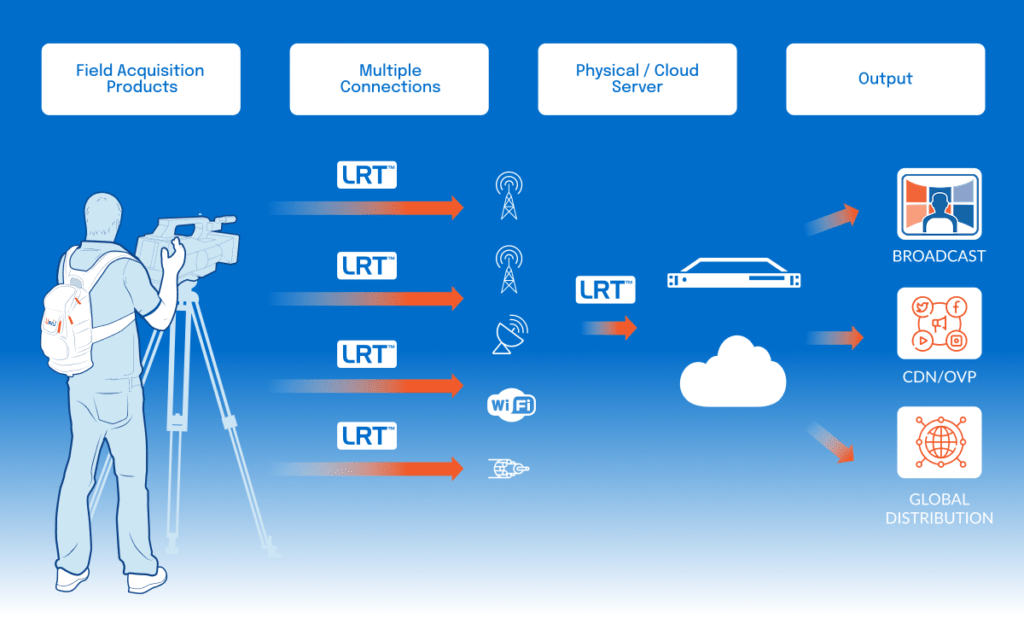
IP bonding and LRT™ working together for reliable live video transmission
With the core technology in place, let’s explore the key considerations that can help you choose the right LiveU encoder for your workflow.
3. Should you choose a portable or fixed LiveU encoder?
a. Portable (on-the-go) production
If you plan to live broadcast on the move, you need a portable unit. A portable encoder lets you go live whenever and wherever the story happens, without being tied to a fixed location. Worn in a backpack or carried in a pouch, it allows you to capture live shots from changing positions and angles, bringing viewers closer to the action.
LiveU offers several broadcast-grade portable units:
- LU300S: A compact, portable encoder for everyday live video coverage. Ideal for any on-the-go live production where a small-sized, reliable encoder is needed.
- LU800: A production-level field encoder supporting up to four fully frame-synced cameras. Designed for premium REMI sports and events with high bandwidth and robust resiliency.
- LU900Q: LiveU’s latest, most advanced portable encoder with modular design and dual-camera support. Powered by LiveU IQ (LIQ™) for superior performance and stability in the harshest network conditions.
What is LiveU IQ?
The LiveU unit, known as “the LiveU backpack”, has become an industry standard for reliable live video transmission across news, sports and live events.
b. Fixed encoders for studio or truck workflows
If you’re broadcasting from a production truck, control room or permanent facility, a fixed rackmount encoder is the best fit. These units are designed for stable uplinks, delivering reliable, low-latency video contribution with fixed-connection latencies as low as ~300 ms, ideal for sports and time-critical productions.
LiveU’s fixed encoders come with or without internal cellular modems. In studios, venues or arenas with strong LAN or fiber, modems act as a dependable backup. In trucks or locations without guaranteed wired connectivity, choosing a model with modems increases resiliency by bonding cellular with the fixed IP connection, ensuring continuity if the primary path drops.
Using bonded IP over the public internet also reduces the need for dedicated fiber or satellite links. Many LiveU customers report up to a 70% reduction in transmission costs when shifting to point-to-point delivery.
LiveU fixed encoder lineup includes:
- LU300Se: Compact point-to-point contribution encoder for small spaces or permanent mounts. Ideal for venues and facilities needing reliable, LAN-first contribution.
- LU610S: Rackmount encoder designed for studios and OB trucks, offering high-quality, low-latency contribution to production hubs.
- LU810: Multi-camera rackmount encoder built for REMI and complex event workflows, supporting synchronized feeds and stable long-distance transport.
The table below summarizes the key differences between LiveU’s portable and fixed encoders to help you select the right unit for your production environment.
| Encoder type | LiveU unit | Typical deployment | Camera support | Best fit for |
|---|
4. Are you streaming to digital platforms, a production facility, or both?
a. Digital channels? Choose between our broadcast-grade units and the LiveU Solo PRO.
If your primary destinations are online platforms such as YouTube, Facebook, Twitch, TikTok or your website, LiveU offers several options suited for digital-first production:
- LU300S / LU800 / LU900Q – Broadcast-grade encoders for advanced digital workflows These units deliver high-quality bonded streaming with flexible connectivity, ideal for teams producing live content across multiple digital platforms. They require a cloud or physical decoder on the receiving end and support advanced capabilities beyond live transmission, including recording, return video, audio/IFB and file transfer.
- Solo PRO – One-touch simplicity for creators and event producers
A portable, easy-to-use encoder designed for creators and smaller production teams who want professional-quality streaming without a full broadcast setup. It supports bonded transmission and up to 4K output to any major online platform and does not require a decoder on the receiving side, making it fast to set up and highly accessible for direct-to-platform streaming.
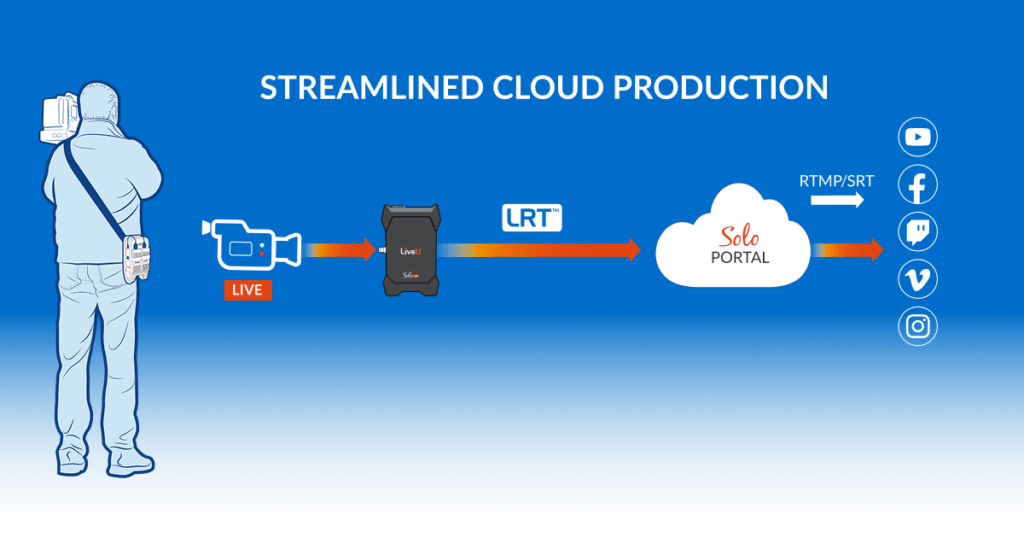
LiveU Solo PRO direct-to-platform streaming workflow
b. Production facility for linear (and digital) distribution? Choose a broadcast-grade unit.
If your live feed needs to be delivered to a production control room – whether on-site or remote –select a broadcast-grade encoder designed for stable contribution over public IP networks.
- LU800 / LU300S / LU300Se / LU610S / LU900Q
These units support low-latency, high-quality contribution into your facility, while also offering the option to stream simultaneously to digital endpoints when required. Paired with a LiveU decoder on the receiving side, your facility can output the feed as SDI for linear workflows or NDI for IP-based production environments.
5. Do you have a single- or multi-camera set-up?
a. Single-camera: choose from a wide range of units
If you are working with a single camera, most LiveU units will meet your needs. The LU300S, LU300Se, LU800 and LU610S all deliver reliable bonded transmission with flexible connectivity for field, venue or studio workflows.
b. Multi-Camera? Choose one of our multi-camera frame-synced units.
Multi-camera production is commonly used for sports coverage, panel discussions, interviews and live events where viewers need more than one angle at the same time.
For productions requiring multiple synchronized angles, LiveU offers units with built-in frame alignment. The LU800 PRO4 and LU810 support up to four fully frame-synced feeds from a single encoder. The LU900Q supports dual-camera production with enhanced resiliency powered by LiveU IQ, making it well suited for complex locations and congested networks. You can also synchronize several single-camera units, such as the LU300S or LU610S, using integrated NTP timecode.
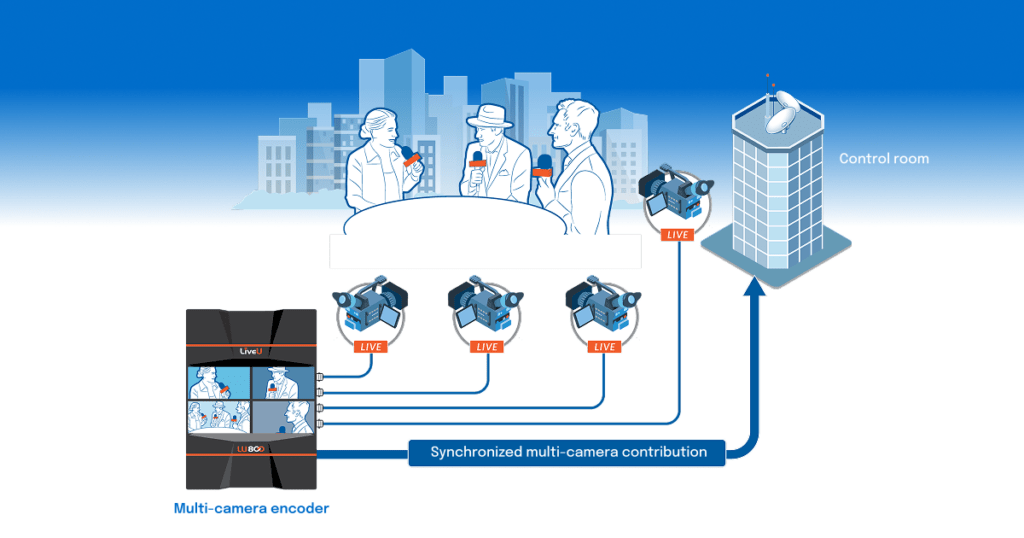
Synchronized multi-camera contribution using a single portable encoder
6. Do you anticipate cellular coverage issues?
a. Challenging network conditions? Choose a unit with more bonded connections.
If you expect to broadcast from congested locations, remote areas or venues with limited network capacity, choosing a unit designed for harsher conditions is critical. These environments often include large sports events, city centers, remote locations or temporary venues where network performance can fluctuate.
Encoder units with more available connection paths and advanced network intelligence provide higher resiliency and more consistent performance. For example, the LU900Q, powered by LiveU IQ (LIQ™), adds intelligent bandwidth management to maintain reliable performance even when conditions change rapidly. It dynamically switches the unit’s eSims, selecting mobile operators that can deliver the strongest set of cellular connections for any given location and time.
LiveU also supports advanced connectivity options such as private 5G, network slicing and satellite integration for productions where public cellular alone is not sufficient.
b. Stable coverage environments? Choose from a range of LiveU units!
If you typically operate in areas with strong and predictable connectivity, such as venues with reliable cellular coverage or access to LAN or WiFi, a wide range of LiveU units will deliver consistent performance. In these environments, teams can focus on workflow and form factor, knowing that bonded IP provides reliable live contribution.
Stable coverage also enables the use of Least Cost Bonding, which allows teams to prioritize lower-cost connections such as Ethernet or WiFi while keeping cellular links available as backup. This helps reduce data usage and transmission costs without compromising reliability, making it well suited for routine productions and repeat deployments.
7. The LiveU Production EcoSystem
Once you have selected the right encoder for your workflow, LiveU’s broader EcoSystem extends its value across production, ingest, orchestration and distribution.
LiveU’s contribution units are part of a complete LiveU EcoSystem designed to support modern production workflows from the moment content enters the pipeline through to final distribution. The platform enables teams to produce, ingest, manage, orchestrate and move live content across IP networks with efficiency and creative flexibility. With solutions for recording, automatic story assignment, cloud production, booking and orchestration and IP digital and linear outputs, teams can produce more content with fewer resources while benefiting from increased automation at every stage of the workflow.
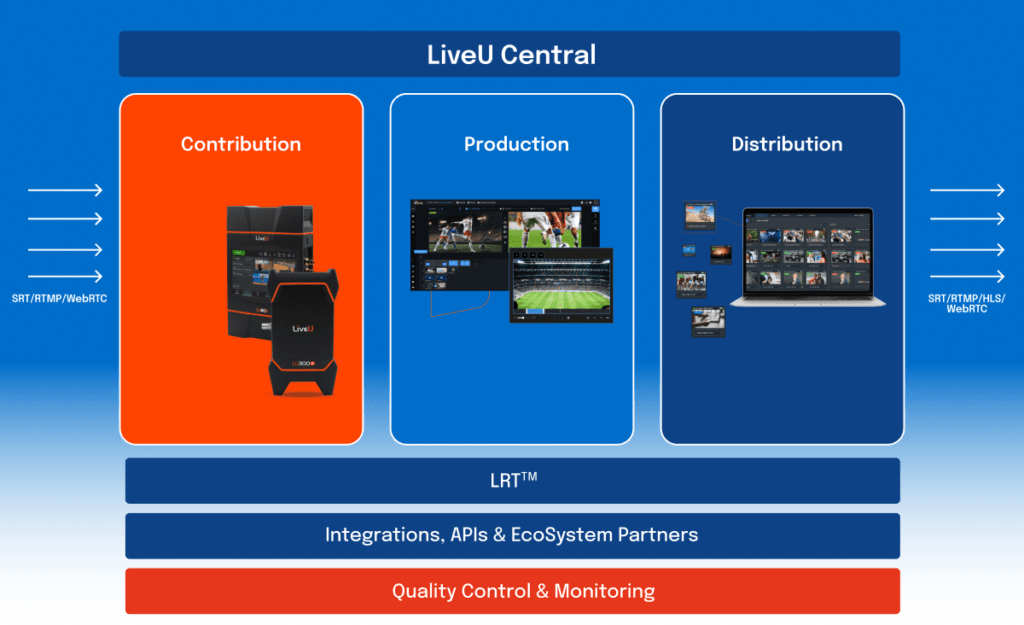
The LiveU EcoSystem: contribution, production and distribution
By considering your specific live production requirements and working through these key questions, you can more easily identify the LiveU encoder that best fits your workflow. Combined with the broader LiveU EcoSystem, these solutions are designed to help teams produce more high-quality content with greater efficiency.