


How LiveU Powered the World's Most Demanding Live Sports Broadcast: Winter Games 2026
The 2026 Winter Games were unlike any before them. Venues stretched across hundreds of miles of northern Italy – from the alpine slopes of Bormio and Cortina d’Ampezzo to the Nordic tracks of Predazzo and the biathlon stadium at Rasen-Antholz. For broadcasters, the production challenge wasn’t just covering elite sport. It was managing live transmission across some of the most geographically dispersed, bandwidth-contested environments on earth.
LiveU was there for all of it.
The Numbers Behind the Coverage
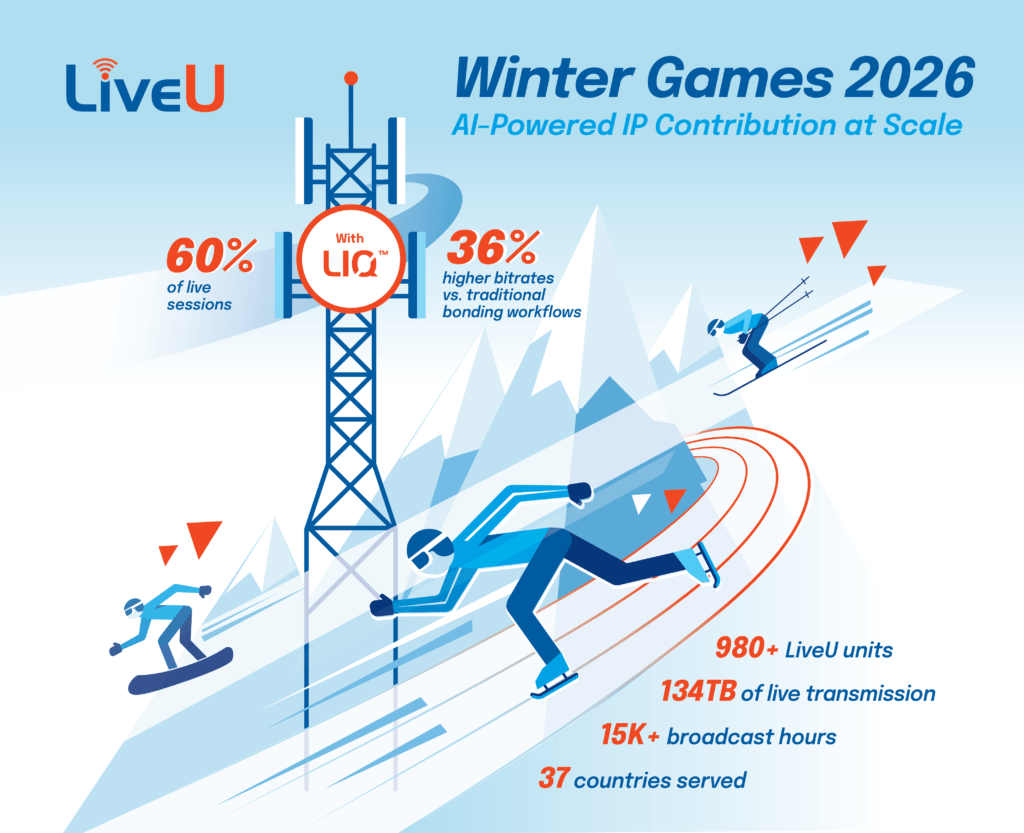
To understand the scale of what happened, start with this: more than 980 LiveU units were deployed across the Games by broadcasters from 37 countries. Together, they delivered over 15,000 hours of live broadcast, transmitting a total of 134TB of live video across nearly 12,000 live sessions – the largest IP-based live production deployment in Winter Games history.
For many broadcasters who relied on LiveU, IP contribution was the primary workflow – for everything from mountain-side athlete interviews and mixed zone coverage to multi-camera studio setups running live in remote alpine towns.
The First Large-Scale Deployment of LIQ at a Global Sporting Event
The Winter Games 2026 marked a significant milestone for LiveU: the first large-scale, real-world deployment of LiveU IQ (LIQ) – the company’s AI-driven connectivity technology – across a global, multi-venue sporting event.
LIQ goes beyond traditional IP bonding. Rather than simply combining available network connections, it uses AI-driven predictive congestion management and real-time network analysis to optimize transmission paths dynamically. At an event like the Winter Games, where thousands of competing devices, crowded cellular networks, and remote mountain venues create constantly shifting conditions, that predictive capability is the difference between consistent 4K delivery and a dropped feed.
The numbers told the story. Around 60% of supported sessions were transmitted using LIQ –and those sessions achieved over 36% higher average bitrates compared to standard IP transmission. Broadcasters delivered consistent 4K and HDR coverage at scale, across every venue, throughout the Games.
“The Winter Games marked a pivotal moment for LiveU,” said Ophir Zardok, Head of Sports Strategy & Business Development at LiveU. “This was the first time LIQ was deployed across a global sporting event of this magnitude. The results validated our vision for AI-driven connectivity – delivering significantly higher bitrates while maintaining rock-solid resiliency across thousands of live transmissions.”
What This Looked Like on the Ground
ORF: Two Base Camps, 200 Miles Apart
Austria’s national public broadcaster ORF offers a clear picture of how LiveU’s deployment translated into real production value.
ORF covered the Games from two base camps – one at Cortina d’Ampezzo for the women’s alpine events, one in Bormio for the men’s downhill at the Stelvio Ski Centre – with its main studio operating back in Vienna. Reporters were also posted at sites where the German medals were expected to be wone. With 17 camera crews spread across venues throughout northern Italy, the broadcaster needed a single, reliable connectivity spine running across hundreds of kilometers of northern Italy.
ORF deployed 23 LU800 units across Milan and Cortina, supported on the ground by LiveU’s local partner ETAS High-Tech Systems GmbH. The connection ran deeper than ENG and mixed zone crews: even the Cortina studio itself – hosted at the historic Jägerhaus in Austria House – ran entirely on LiveU, including the two studio cameras used for athlete interviews.
“We have all these outside studios based on LiveU connections,” said Michael Kögler, ORF chief director. “They’re all coming in on LiveU from all the mixed zones; from everywhere. Even the studio set up in Cortina is based on LiveU’s as well, with two cameras in the studio just for interviews.” (SVG Europe)
Christian Zettl, ORF TV production manager, added: “The LiveU deployment gave us maximum flexibility and optimal conditions for bringing the Olympics into our viewers’ living rooms as comprehensively as possible, while also contributing to significant savings in production costs.”
France Télévisions: LiveU Across Six ENG Crews and a Transportation Studio
France Télévisions based its entire Winter Games operation at the IBC in Milan, covering venues spread across northern Italy with six ENG crews – equipped with LiveU units in the mixed zones. (SVG Europe) The project was managed by LiveU’s partner Videlio Events.
LiveU also powered something more unusual: the broadcaster’s “teleportation” system, which allowed athletes and presenters to appear live inside the main studio in Milan via greenscreen.
At the midpoint of the Games, France Télévisions had reached 43 million viewers who had watched at least one minute of coverage – 10 million more than at the same stage of both Beijing Games 2022 and PyeongChang Games 2018, and the highest level since 2006. Its streaming platform, france.tv, recorded 21 million video views, already surpassing totals from the entire duration of both previous Winter Games.
NOS: Extending Hilversum to the Dolomites
For a broadcaster without a large on-site technical crew, confidence in the workflow is everything. Dutch public broadcaster NOS took a similar approach. LiveU-equipped crews in Cortina finalized their own edits on location and transmitted directly back to Hilversum – bypassing the IBC where the workflow allowed. (SVG Europe)
“With LiveU, my philosophy is always that you want to send it to the final destination where it needs to go… What we try to do here is come up with a workflow that is very similar to what everyone is used to back in Hilversum – so all the people that come here know the workflow in place, and it basically feels like they are back in Hilversum.”
That kind of workflow continuity – using LiveU to make a remote Games production feel like a home operation – is how broadcasters are increasingly thinking about IP contribution. Not as a new technology to adapt to, but as a transparent extension of infrastructure they already know.
NBC Sports: 54 LiveU Feeds at the Heart of an All-IP Winter Games
No broadcaster pushed the IP-production model further at the games than NBC Sports. Running its entire Games operation from the Stamford, CT Broadcast Center – which SVP Darryl Jefferson called “the anchor point of the whole show” – NBC depended on a contribution infrastructure that carried nearly 500 video paths between Italy and the US. Of those, 54 were LiveU encoded feeds, sitting alongside 216 JPEG XS and 210 HEVC streams as core production paths, not fallbacks. (SVG, Live From Stamford)
In Cortina, NBC’s curling venue team deployed four-channel LiveU packs in the mixed zones for live talent coverage. And across every competition venue in Italy, NBC added a dedicated LiveU camera to capture cutaway shots of athletes’ friends and family – a storytelling layer that became central to NBC’s production identity at the Games.
At the audio level, Stamford-based A1 engineers used LiveU units for cellular-based audio and video contribution from various positions throughout Italy, with Dante networking allowing remote control of microphones in the field. (SVG Europe)
NBC’s Paralympic Workflow: Cloud-First, LiveU-Powered
NBC’s commitment to LiveU didn’t end when the games flame went out. For the Milan Cortina Para Winter Games (March 6–15), the broadcaster took its IP-first workflow a significant step further – abandoning dedicated circuits at the IBC entirely in favor of a cloud-native signal transport model. NBC deployed 10 LiveU backpacks for unilateral feeds, mixed-zone interviews, and roaming coverage across venues in Cortina and Milan – with all content flowing directly to Stamford via OBS cloud instances in Virginia and Frankfurt, no in-country Broadcast Operations Center required. (SVG)
“This is the first time we haven’t had a connectivity presence from the IBC for the Paralympics,” said Chris Connolly, VP, Sports and Olympics Engineering, NBC Sports. “We are using SRT and the internet and, in Stamford, CT, gateways to get 14 signals from the cloud via two cloud instances: one in Virginia and another in Frankfurt. Both of those cloud services are active and provide redundancy.”
NRK: Bonded Connectivity as the Only Affordable Path Home
For Norwegian public broadcaster NRK, returning to the Winter Games after a 14-year absence from full free-to-air rights, the Games represented one of its largest-ever production undertakings – and bonded transmission was the connectivity model that made it financially viable.
With dedicated fiber connections between Italian venues prohibitively expensive, NRK deployed 10 ENG crews across Italy using bonded technology for all transmissions back to Oslo. The roving teams on the ground used LiveU technology to transmit. Production director Jostein Jære Fjeldskår explained the logic: “The dedicated fiber connections just within the Games from one point to the IBC is too expensive for us, so we are relying heavily on bonded technology.” (SVG Europe)
The result was a control-room operation in Oslo receiving live content from across Italy in real time – a full remote production model at Winter Games scale, made possible by IP bonding rather than traditional broadcast infrastructure.
Why This Matters Beyond the Medals
The scale of LiveU’s presence for the games reflects something bigger than any single broadcaster’s production model.
“What we’re seeing is a fundamental acceleration toward intelligent, IP-based production,” said Zardok. “Broadcasters are no longer asking whether IP can handle premium live sports –they’re asking how far they can scale it.”
The Winter Games accelerated a shift that had been building for years. With broadcasters from 37 countries relying on LiveU as their primary contribution tool – and LIQ delivering measurable, quantified quality improvements at global scale for the first time – the debate over whether IP can match satellite or fiber at major events is increasingly being settled. In practice, it already can.
What Comes Next: 2026 World Football Championship
The momentum from Italy now points directly at the next great test: the 2026 world football championship, running June 11 through July 19 across 16 host cities in the United States, Canada, and Mexico – the most geographically dispersed tournament in its history.
The production scale is staggering. A record 48 teams compete across 104 matches over 39 days, spanning three countries, three time zones, and venues from Vancouver to Miami. Host broadcast production will be anchored at a centralized IBC in Dallas, with 16 dedicated production teams distributed across host cities to minimize travel and localize operations.
The football tournament also brings an entirely different set of pressures: stadiums holding 70,000 to 87,000 fans with every broadcaster in the world competing for the same cellular spectrum, simultaneous matches across multiple cities demanding parallel transmission capacity, and the weight of the world’s most-watched sporting event on every single feed.
LIQ was built for exactly these conditions. Its AI-driven predictive congestion management doesn’t just react to network problems – it anticipates them, routing around interference before a dropped frame occurs. At the Winter Games, that translated into 36% higher average bitrates across crowded alpine arenas. At World Cup scale, that predictive intelligence becomes even more critical.
980 units across 37 countries trusted LiveU at the Winter Games 2026. The summer of football is next.
Planning your production workflow? Let’s talk. Speak to the LiveU sports team →