


Election Night FAQs: Modern Coverage Workflows for Linear TV & Digital Media
Following our recent webinar, “Stay Live on Election Night: What News Teams Need to Know for 2026,” we sat down with our sales expert to answer the top questions submitted by news directors, chief engineers, and digital content leads.
Below, we explore the evolving landscape of political coverage, how top newsrooms are scaling multi-location operations, and how the LiveU Ecosystem simplifies remote production from headquarters to the field.
Industry Trends & Election Coverage Dynamics
Election Night is no longer confined to a single prime-time broadcast window. Today’s audiences expect continuous live updates across social media platforms, mobile apps, OTT channels, and traditional linear channels simultaneously.
To manage this without doubling production budgets, news organizations are moving away from duplicate production teams. Instead, they deploy a “capture once, publish everywhere” model. A single field crew equipped with a bonded cellular unit can simultaneously feed the main control room for broadcast while routing sub-streams or secondary multi-camera angles directly to cloud production platforms for digital breaking news updates.
Network congestion and unpredictability. When hundreds of journalists, campaign staff, and voters gather at a campaign headquarters or debate venue, local cellular towers instantly choke under heavy data demand.
Historically, this forced newsrooms to reserve expensive satellite trucks or dedicated fiber lines. Today, the challenge is maintaining broadcast-quality transmission resilience and low latency using agile, handheld or backpack field encoders – even when local 4G/5G networks are severely overloaded.
Production Trends & Efficiency Opportunities
The key is adopting REMI and cloud-centric workflows. Sending full production crews, OB vans, and satellite trucks to 20 or 30 local race locations is cost-prohibitive.
By standardizing on portable IP field units, media organizations send minimal gear and staff to candidate watch parties while keeping senior directors, graphics operators, and editors back at central headquarters or working remotely. Feeds are aggregated, edited, and distributed entirely in the cloud, cutting travel and hardware expenses by over 70%.
Speed to air wins the audience. Manual file transfers, unindexed video clips, and tedious logging create bottlenecks that slow down both broadcast lower-thirds and social media clips. Automated metadata logging connects field assignments directly to Newsroom Computer Systems (NRCS). When a camera operator selects an assigned story on their field unit, footage is automatically ingested, tagged, and instantly made searchable for cloud editors in real time.
Technology Spotlight: The LiveU EcoSystem in Action
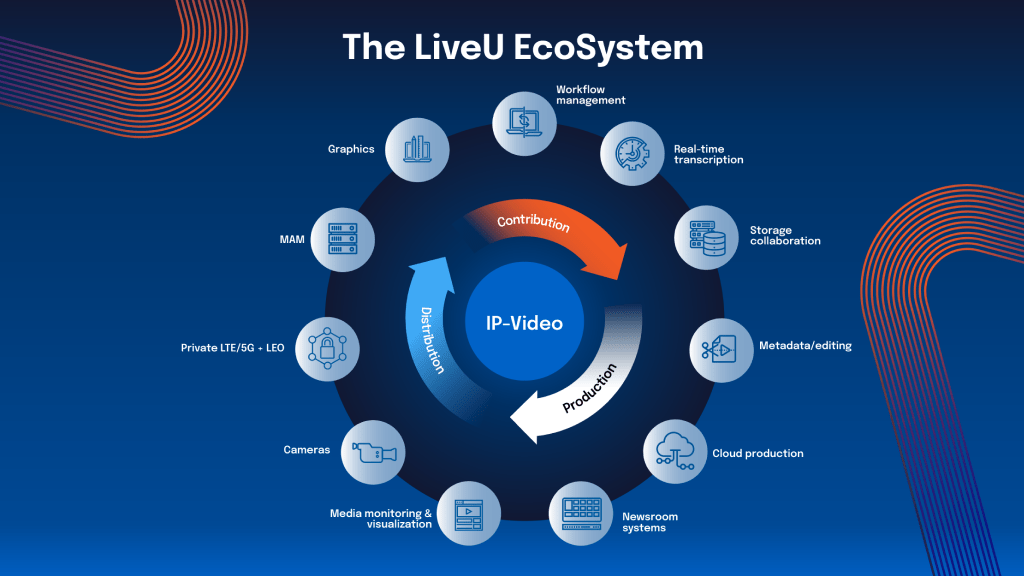
The LiveU EcoSystem is a unified architecture that connects every stage of the live video lifecycle – Create, Produce, Manage, Share, and Connect. Rather than piecing together disparate hardware encoders, third-party cloud switchers, and manual file transfer protocols, LiveU provides an end-to-end framework. Field crews broadcast with maximum connection reliability, central engineering routes signals with zero friction, and production teams distribute.
LiveU IQ™ (LIQ) is an intelligent connectivity solution that dynamically optimizes carrier selection in real time. Traditional multi-SIM bonding relies on fixed, pre-assigned mobile network operators. If local towers for Carrier A become congested, those modems stall.
LIQ uses cloud algorithms and multi-eSIM technology to analyze network performance continuously, automatically switching modems seamlessly to whichever carrier offers the highest throughput and lowest latency at that exact location. It eliminates connectivity bottlenecks without requiring manual operator intervention.
The LU900Q delivers high-end multi-camera broadcast capabilities in a compact, field-ready form factor. Equipped with 6 internal 5G modems, high-efficiency MIMO antennas, and native LiveU IQ support, it guarantees rock-solid transmission up to 4K resolution.
For election coverage, its ability to transmit multiple synchronized camera feeds from a single unit allows field reporters to run a main host shot alongside a secondary wide angle or press podium feed – all without needing a second encoder or extra uplink gear.
LiveU Ingest automates video recording and story metadata tagging directly from the field. As live footage streams back from a candidate rally, LiveU Ingest automatically records and indexes the video in the cloud while attaching story tags from your NRCS. Digital editors can trim clip highlights immediately while the speech is still happening, pushing short-form video to app feeds and social channels without waiting for a broadcast wrap.
Yes, using LiveU Studio. LiveU Studio is a cloud-native live video production platform that allows teams to switch feeds, add graphics, mix audio, and insert guest callers directly from a web browser. Digital teams can pull live feeds from field reporters, switch an election night panel show, and push streams to 30+ digital destinations simultaneously – all without taking up main control room resources.
LiveU Matrix is a cloud-native IP video distribution platform that simplifies content syndication. During elections, state-wide or national broadcast groups often share pool feeds of major acceptance speeches or voting centers. Matrix allows station networks to distribute live feeds to dozens of affiliates with one click, cutting traditional satellite distribution costs by up to 70%, while enabling seamless cloud recording.
Scaling and Connecting the Ecosystem
LiveU Nexus makes this simple. It can ingest a live Zoom call, YouTube stream, Facebook Live, or any web-based source directly with just a URL or meeting link. No special hardware or technical workarounds required. A producer can pull a candidate’s live Zoom remarks straight into the broadcast chain alongside field crew feeds, all through the same interface.
That’s exactly what LiveU Nexus is built for. As the API-powered gateway to the LiveU EcoSystem, Nexus can simultaneously feed a single IP stream into LiveU Studio, LiveU Ingest, and LiveU Matrix at once. Producers and editors get a drag-and-drop interface to move live video across contribution, production, and distribution – no technical training or manual reconfiguration required, even as the number of incoming sources multiplies through the night.
This is where LiveU’s cloud-native tools pay off. LiveU Studio runs on a usage-based, scale-on-demand model. Stations can spin up additional production capacity for election night and scale back down once coverage wraps, paying only for what they use. LiveU Record, available as a cloud service or on-premises deployment, gives digital and content teams a browser-based DVR that can be provisioned for peak-night volume and then dialed back down. And LiveU Nexus lets teams route feeds using existing LiveU servers, on-prem or in the cloud, so infrastructure already in place keeps working alongside newly scaled cloud capacity. Together, these tools let newsrooms handle the biggest night of the cycle without committing to expensive permanent hardware that’s only needed once every few years.
Ready to Elevate Your Election Coverage?
Whether you need to upgrade your field fleet with LU900Q units powered by LIQ™, or streamline your distribution using LiveU Matrix and LiveU Ingest, LiveU’s solutions scale to meet the demands of 2026’s biggest news night.