




The Story Is the System: Automating Ingest for the Story-Centric Newsroom
TL;DR
The pressure is real
Newsrooms today publish everywhere, all at once: linear TV, web, social, streaming, sometimes within minutes of a story breaking. That shift has happened faster than most technology stacks were built to handle. According to the Reuters Institute’s 2026 Trends and Predictions report, 97% of news executives now rate back-end automation as important to their business.
That’s not a niche opinion. It’s near-universal agreement that the systems behind the scenes need to catch up to how content actually moves today. The question most newsrooms are still working through isn’t whether to automate. It’s what, and where, automation actually needs to start.
What does ‘story-centric’ actually mean?
“Story-centric” has become one of those terms every vendor uses and few define the same way. Said enough times, it starts to mean everything and nothing.
Here’s the concrete version: a story-centric workflow means every piece of content, live, file, or clip, is connected to the story it belongs to from the moment it’s captured, not stitched together after the fact. One story, one metadata thread, followed all the way from the field to air. That’s a meaningfully different operating model from the rundown-first, platform-first approach most newsroom technology was originally built around.
Where the story usually breaks down before it reaches the newsroom
Most of the conversation around story-centric workflows focuses on planning and rundown tools, and rightly so, that’s real progress. But there’s a gap just before it: the moment content actually arrives.
That’s usually where things still break down. A field crew calls the ingest room to say a feed is coming in. An operator manually starts a recording, sometimes missing the first minute. Metadata gets typed in by hand, if it gets entered at all, disconnected from the story it’s actually part of. Multiply that across a live news day, and the result is delay, inconsistency, and content that shows up in the MAM without the context anyone needs to find or use it quickly.
Planning systems assume the content has already arrived, tagged and ready. The real question is what happens right before that.
Automating the front end: recording, sources, and scheduling
This is where LiveU Ingest operates: as a story-centric content ingest automation layer for the moment content is captured.
Recording
Ingest automatically records live feeds, whether they come from a LiveU field unit, a satellite feed, a fiber circuit, or another vendor’s encoder, one recording and ingest workflow, regardless of source. And it doesn’t wait for the recording to finish: producers and editors can work from the growing file while it’s still being recorded, instead of waiting until the feed ends.
Metadata
Every one of those recordings carries story metadata from the start, not added afterward. That metadata originates upstream, in the newsroom system where the story itself is created, whether that’s Saga, Dalet, iNews, ENPS, or another leading NRCS, and follows the content the whole way through. Practically, that means a recording doesn’t just exist as a file somewhere, it arrives already labeled with which story it belongs to, ready to be found and used.
Beyond live
The same principle applies to non-live content: files and clips brought in directly from the field, whether that’s raw footage from a laptop, a phone, or a camera’s memory card. These carry the same story metadata as a live recording, so a reporter’s phone clip and a studio camera feed end up organized the same way, under the same story, in the same workflow.
Orchestration
The last piece is when recording happens. Ingest orchestrates recording through LiveU Schedule or an open third-party scheduling API, supporting both time-based recording and event-triggered recording. That replaces the manual “someone has to remember to hit record” model with a system that starts and stops on its own, based on a schedule or a triggering event, rather than a person watching a clock.
Put together, content arrives already recorded, already tagged with its story, and already timed correctly, then lands in the MAM system the newsroom already uses to manage and publish it, carrying the same story context that started back in the NRCS. The loading dock stops being a bottleneck, nothing sits there waiting for someone to open it, work out what it is, and carry it to the right shelf by hand.
What this looks like for one story
Here’s what all of that actually looks like, followed through a single story from kickoff to air.
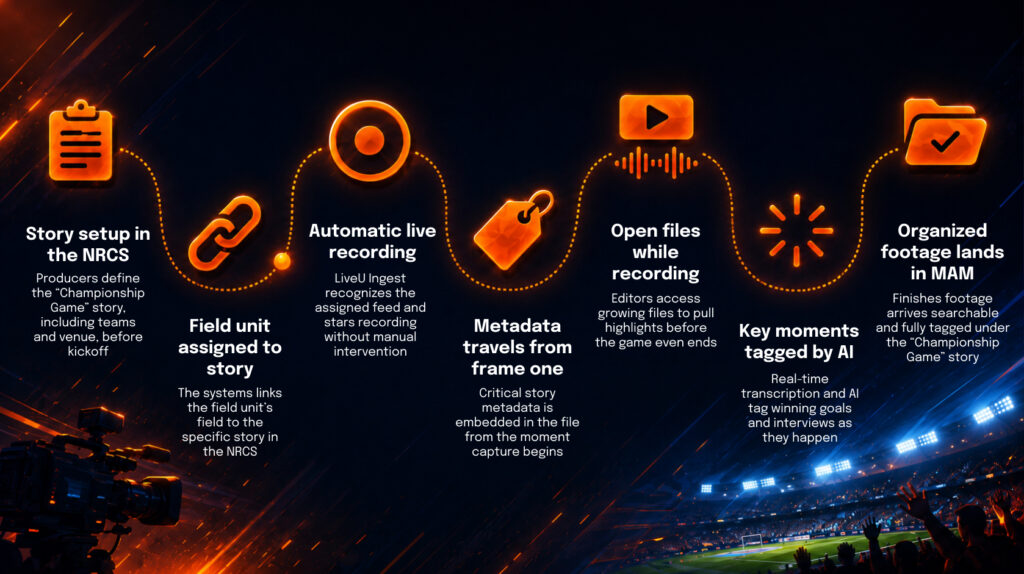
In practice, this means a producer creates the story in the NRCS and assigns the covering unit before it even goes live. The moment that unit starts transmitting, LiveU Ingest recognizes it and begins recording automatically, attaching the story’s metadata from the first frame. Editors can work from the growing file while it’s still recording, and by the time the story wraps, the footage has already been enriched and delivered into the MAM, tagged and ready to publish.
The industry is building toward this at the standards level
This isn’t just LiveU’s read on where things are headed. It’s becoming an industry-wide effort, at the standards level. The 2026 IBC Accelerator Incubator project: Smart Stories – The New Knowledge Architecture for Content Production, backed by leading broadcasters and media players, is building the Story Object Model (SOM): an open standard giving every connected production tool, from graphics to compliance to archive, a shared structure for a story’s context, so they’re all working from the same picture as it evolves. Through our work with the incubator, LiveU is contributing its experience automating story metadata at the point of capture to help shape how the standard handles content from the moment it’s captured, not just once it reaches a newsroom system. This is a natural extension of the same principle Ingest already applies at the point of capture: content should carry its story context with it, not have that context reconstructed later by someone piecing it back together. SOM also connects to TAMS (Time-Addressable Media Store), an open standard for frame-accurate media addressing, meaning the industry is now working toward content that is both story-aware and frame-addressable from the moment it’s captured, the same outcome Ingest is built to deliver today, extended across the wider production chain.