



Public Safety Mission Ready Series:
Q&A Guide
Automated PACE for the ultimate resiliency
In mission-critical operations, public safety teams need the right information at the right time to make faster, safer decisions. When lives are on the line, technology shouldn’t require you to act as an IT manager. It needs to work quickly, reliably, and effortlessly.
For two decades, LiveU has served as the undisputed backbone of live broadcasting, trusted by top news networks to deliver video from the world’s most demanding environments. Today, we are bringing that same battle-tested, resilient connectivity directly into public safety workflows.
Below, we’ve compiled a quick-reference Q&A guide to help you navigate field deployment, resiliency, and real-time operational awareness using IP video.
Given the scope of these technologies and the evolving nature of the industry, we’ve split this guide into two parts. Dive into Part 1 below.
Q: Who is LiveU, and why does broadcast-grade video technology matter to Public Safety?
For two decades, LiveU has been the global standard for live news broadcasting in harsh, unpredictable network conditions. Public safety agencies face those exact same connectivity challenges when operating in disaster zones, congested events, or remote locations. LiveU brings that same battle-tested reliability to emergency management, law enforcement, DOT, and first response teams. Our goal is to connect field teams, drones, vehicles, and command centers in real time with sub-second latency.
Q: What is the LiveU EcoSystem and how does it solve the problem of fragmented tools?
Many agencies currently deal with siloed, disconnected tools and disparate applications for drones, manned and unmanned vehicles, fixed and temporary surveillance sensors, vehicle cameras and various special response teams (SRT). Built on an open architecture, the LiveU EcoSystem functions as a unified transport and management layer. It gathers visual intelligence (VISINT) from air, land, or sea and aggregates it into a single Common Operating Picture (COP). It integrates directly into the software and video management platforms your agency already uses (VMS, GIS, SCADA, RTCC software), meaning you don’t have to overhaul your existing technology stack.
Q: Can you walk me through the LiveU EcoSystem products that are relevant to the Public Safety market?
LiveU’s portable, rugged field units like the LU-REQON1 and multi-channel LU900Q or LU800 field units reliably transmit real-time video from any source to any destination. Built for your needs, it’s compatible with leading drones and uncrewed systems, ensuring critical mission visibility. LiveU field units leverage LiveU’s patented LRT™ protocol and l, and LiQ™ (LiveU Intelligent Quality), combining 4G/5G, Wi-Fi, Ethernet, and Satellite to deliver a single, robust pipe, which keeps mission-critical data flowing where standard single-SIM solutions often fail.
Other valuable capabilities include VideoBridge (live/store-and-forward video), DataBridge (resilient field Wi-Fi/Ethernet hub), FileBridge (rapid file/folder transfer), and RadioBridge (LMR audio integration). I will dig further into those features a little further down.
Rounding our ecosystem of management and production tools: LiveU Central (C2 unified cloud device/feed management), LiveU Ingest (optional automatic recording & metadata transfer), LiveU Matrix (cross-agency feed sharing), and LiveU Studio (cloud production/PIO briefings).
Q: Can you walk me through the LiveU EcoSystem products that are relevant to the Public Safety market?
The LU-REQON1 encoder was built for fast deployment with a single video input. It is ideal for drones, mobile teams, vehicles, and temporary hot zones. The LU900Q field encoder is designed for a broader mission platform supporting dual video inputs. It handles real-time video, secure file transfers, data workflows, and precise GPS location tracking in a single unit.
Q: How do LRT, LiQ, and A-PACE keep feeds live in congested or remote areas?
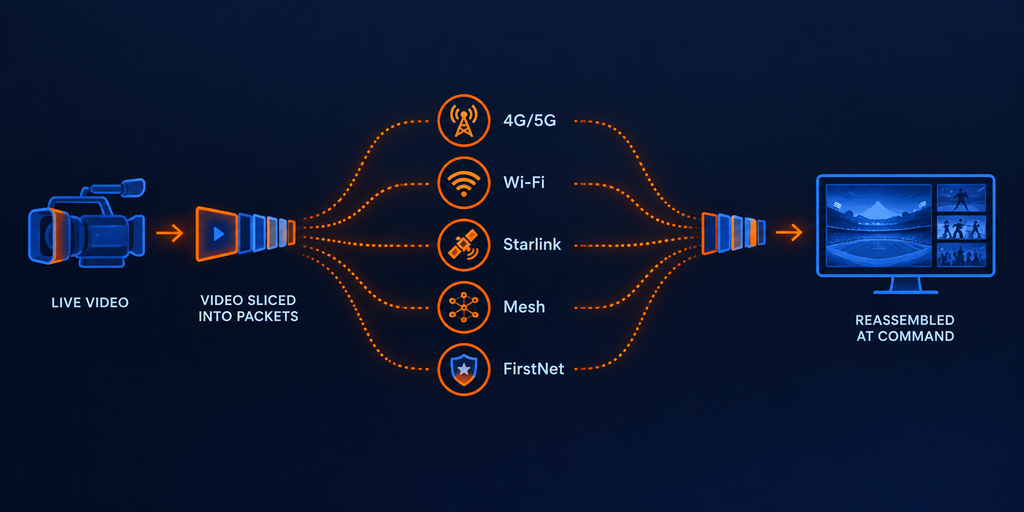
LiveU Reliable Transport (LRT)uses IP bonding to combine multiple networks simultaneously including 4G/5G cellular, Wi-Fi, satellite (such as Starlink), mesh networks, and FirstNet – slicing up video data and routing it across available networks before reassembling it seamlessly at command. LiveU IQ ™ (LIQ ™) automatically monitors network fluctuations in real time and dynamically adapts bitrates to ensure continuous, uninterrupted video transmission during an active mission. Automated PACE approach supports Primary, Alternate, Contingency, and Emergency connectivity layers to eliminate single points of failure.
Q: What is VideoBridge, and how does it support mission flexibility?
VideoBridge allows agencies to adapt video transmission based on real-time mission requirements and network conditions. It supports live streaming for immediate situational awareness, as well as store-and-forward workflows to capture high-res footage when network coverage is completely unavailable and send it automatically once connected.
Q: How does DataBridge turn field units into a mobile connectivity hub?
DataBridge transforms a LiveU field unit into a bonded, high-speed Wi-Fi hotspot or Ethernet router. Instead of relying on a single cell modem, it bonds all available cellular and satellite connections to power field laptops, tablets, drone docks, controllers, and tactical apps in remote or disaster-stricken environments.
Q: How does FileBridge/Folder Transfer accelerate post-event analysis?
FileBridge transfers large video files, drone mapping folders, and high-res imagery directly from the field into HQ systems at speeds up to 2 GB per minute. Files route directly into LiveU Ingest or connected VMS platforms, making them instantly accessible anywhere in the world. It eliminates manual SD card/USB handoffs and speeds up incident reviews, damage assessments, and investigations.
Q: How does RadioBridge integrate with traditional radio systems?
RadioBridge extends Land Mobile Radio (LMR) systems directly into the wider LiveU EcoSystem. Audio can be connected via approved headset interfaces on field units or through the LiveU Control+ app. It allows traditional radio users, drone operators, and central command to stay in the exact same voice environment across long distances.