


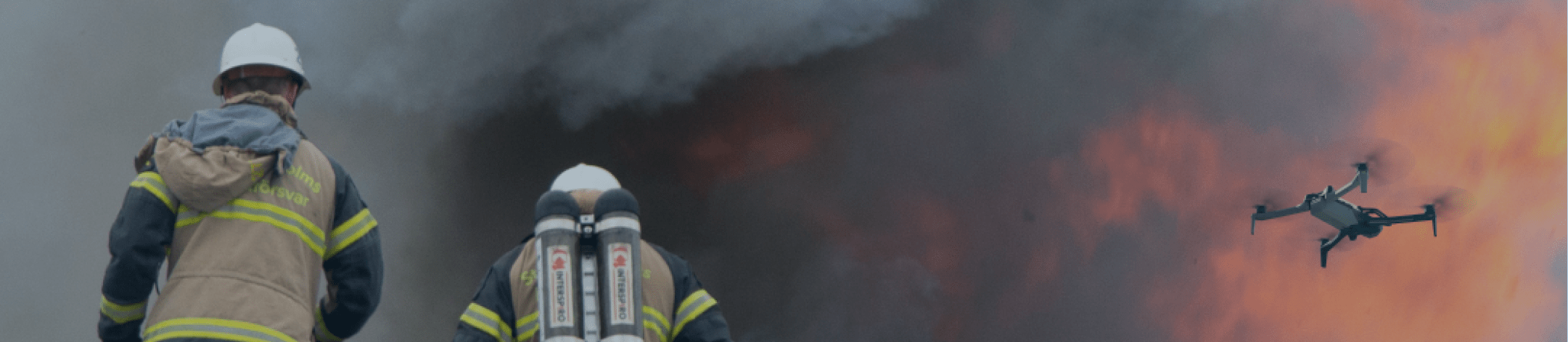
Drones as First Responders: Redefining Critical Infrastructure
TLDR: How are drones transforming emergency response and critical infrastructure protection?
The Growing Role of Drones in Critical Infrastructure and Emergency Response
In an era where every second counts in emergency response, unmanned aerial systems have emerged as transformative tools. As such, they are in a unique position that warrants recognition as both part of critical infrastructure operations and as part of US critical infrastructure – an essential system that preserves public safety and national security. Drones equipped with advanced sensors, real-time communication systems, and rapid deployment capabilities are revolutionizing how we protect communities, secure vital assets, and save lives. Their integration into public safety operations represents not merely a technological advancement, but a fundamental shift in our approach to emergency management and national security.
Law enforcement agencies nationwide have discovered that drones provide unprecedented tactical advantages in protecting and serving communities. These aerial platforms enable officers to evaluate dangerous situations from safe vantage points, locate suspects in challenging terrain, document crime scenes with precision, and conduct search operations that would otherwise require dozens of personnel and hours of time. When deployed as first responders, drones can arrive at incident scenes within minutes, providing critical intelligence to ground units before they enter potentially hazardous environments. This capability has proven invaluable in active shooter scenarios, barricaded subject situations, and large-scale public events where situational awareness can mean the difference between tragedy and successful intervention.
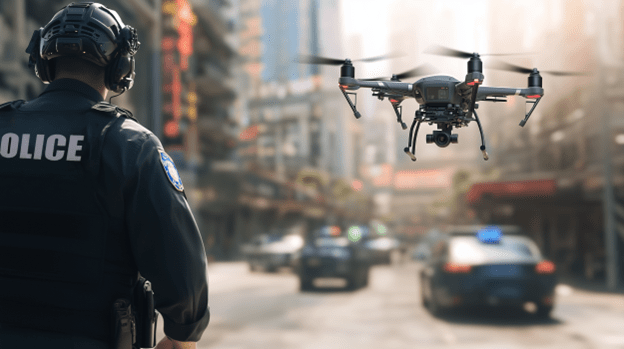
The Operational Importance of Secure, Real-Time Drone Video for Public Safety Operations
The effectiveness of drone-based first response hinges entirely on secure and reliable data transmission. Federal and state law enforcement agencies require reliable, real-time video feeds and telemetry data that cannot be intercepted, manipulated, or disrupted by adversaries. When FBI agents conduct surveillance operations, DEA teams track narcotics trafficking, or state police coordinate multi-jurisdictional pursuits, compromised communications could expose officers, jeopardize investigations, and endanger the public. Secure transmission infrastructure ensures that sensitive operational data remains confidential; video evidence maintains chain of custody integrity, and command centers receive uninterrupted situational awareness. Without this foundational security, drones transition from force multipliers to potential vulnerabilities in law enforcement operations.
Drone Surveillance and Real-Time Video Intelligence for Critical Infrastructure Protection
The protection of critical infrastructure demands constant vigilance across vast geographic areas – a challenge perfectly suited to drone capabilities. Energy facilities, water treatment plants, transportation networks, and communication systems require regular monitoring to identify vulnerabilities and respond to threats.
Drones equipped with thermal imaging and gas detection sensors can inspect thousands of miles of pipeline, identify potential security breaches at power substations, and assess structural integrity of bridges and dams with efficiency impossible through traditional means. Their ability to operate in hazardous environments protects inspectors, while ensuring continuous infrastructure security.
The sensors are the brains of the drone mission and must deliver real-time video intelligence to command centers, enabling commanders to make decisions based on actual ground conditions. This video intelligence – as validated by multiple federal and state emergency agencies – must be reliable even under the most constrained and contested conditions. This is precisely where the first responder community has turned to LiveU.
LiveU’s Bonded Cellular Technology: Ensuring Mission-Critical Reliability
Founded in 2006, LiveU pioneered bonded cellular technology which aggregates multiple cellular connections into a single, robust transmission stream. This approach ensures uninterrupted video delivery even when individual network connections falter or fail. Where traditional single-carrier solutions drop out in challenging environments – whether due to network congestion, limited infrastructure, or interference – LiveU’s bonded cellular technology maintains a reliable link by seamlessly combining multiple network connections into one unified, high-capacity uplink, ensuring that even if a single connection weakens, the bonded stream remains stable and continuous.” For first responders and emergency management teams operating in crisis situations, this reliability isn’t just a feature – it’s mission-critical.
LiveU’s technology has proven itself in the field, delivering clear, uninterrupted intelligence when it matters most, enabling faster response times and more informed decision-making in life-or-death scenarios.
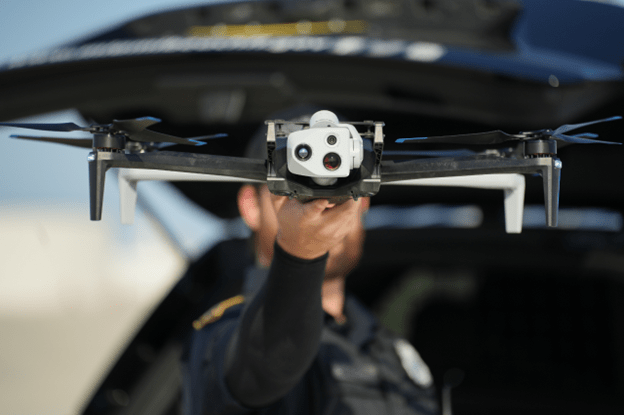
Drones as Force Multipliers for Fire, EMS, and Disaster Response
Emergency responders face increasingly complex disasters that demand rapid assessment and coordinated response. Drones serve as force multipliers for fire departments, EMS providers, and rescue teams by providing aerial reconnaissance during structure fires, delivering medical supplies to isolated victims, and locating individuals in wilderness areas or collapsed structures. During natural disasters, when traditional infrastructure fails, drones become essential tools for damage assessment, survivor location, and resource allocation. They can map flood zones, identify safe evacuation routes, and coordinate multi-agency responses with real-time aerial intelligence.
Defense operations increasingly rely on unmanned systems to protect installations, monitor borders, and support tactical missions. Drones provide persistent surveillance capabilities that enhance base security, support force protection operations, and enable rapid threat assessment without risking personnel. Their integration with existing defense infrastructure creates layered security systems that respond dynamically to emerging threats.
The designation of drone systems as critical infrastructure reflects their essential role in modern emergency management. Just as we recognize communications networks, energy grids, and transportation systems as vital to societal function, we must acknowledge that unmanned aerial systems have become indispensable tools for public safety. Investment in drone infrastructure, training, and technology development represents an investment in community resilience, operational effectiveness, and the fundamental capability to protect lives and property in an increasingly complex threat environment.
To learn more about our Public Safety Solutions for critical infrastructure, visit https://www.liveu.tv/solutions/public-safety/situational-awareness.
Eric Buer serves as Senior Director of Sales and Business Development for LiveU’s Public Sector Division, where he aligns advanced technology solutions with complex operational requirements. With progressive leadership experience across aerospace and technology sectors, he brings extensive expertise in government acquisition, program management, and enterprise business development.