




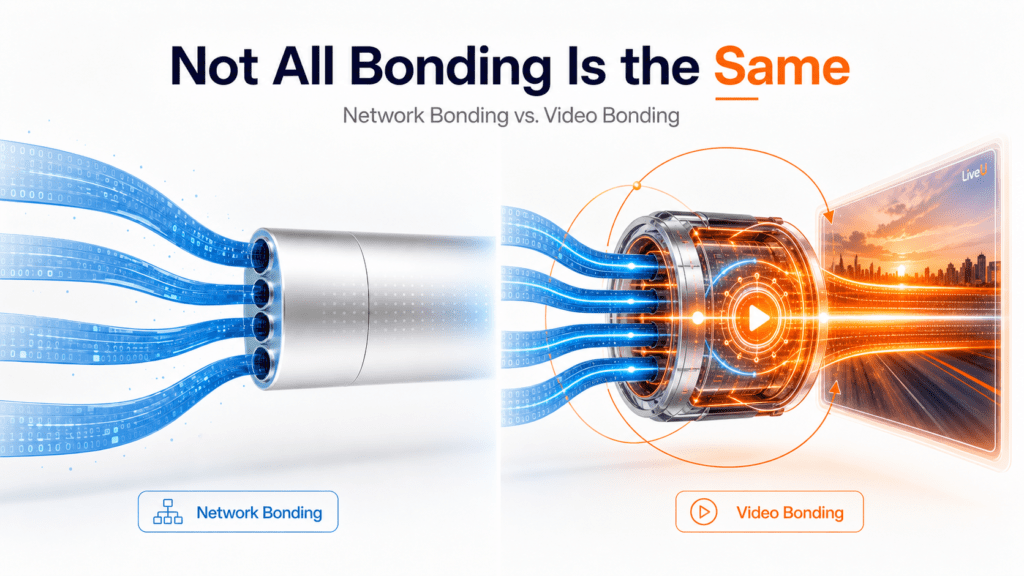
Not All Bonding is the Same
Key Takeaway
Full disclosure: I work at LiveU. But I didn’t always 😊. Before joining LiveU, I spent several years as director of news technology at a local news station in Boston – where we actually ran both solutions simultaneously. We used a general-purpose bonding router in our vehicles for reliable internet connectivity, and LiveU for broadcast video transmission. We even fed the router connection into LiveU as an additional bandwidth source when we needed it. That experience is what makes the distinction in this article so clear to me – and it’s a distinction I wish someone had explained to me earlier, because it’s not obvious from the outside.
If you’ve been shopping around for a live video transmission solution, you’ve probably come across the term “cellular bonding” on products touting reliability and stability – that have nothing to do with broadcast. They all bond cellular connections. So do we. But what’s happening under the hood is completely different – and if you’re planning a live broadcast, that difference matters a lot.
So – what’s the difference?
What Is General-Purpose Network Bonding?
Think of your internet connection as a water pipe. One cellular connection gives you one pipe. If that pipe gets narrow or breaks, your water pressure drops.
Network bonding tools like Peplink, Cradlepoint, and Speedify take multiple pipes – say, four different SIM cards from different carriers – and combine them into one larger pipe. More pressure, more reliability. If one pipe breaks, the others keep flowing.
That’s genuinely useful. It’s how emergency services keep communications up on the move. It’s how remote offices stay connected in areas with no fiber. It’s how TV news vans get a solid internet connection while driving. These tools are well-engineered for exactly that job.
But here’s the thing:
They don’t know what’s flowing through the pipe.
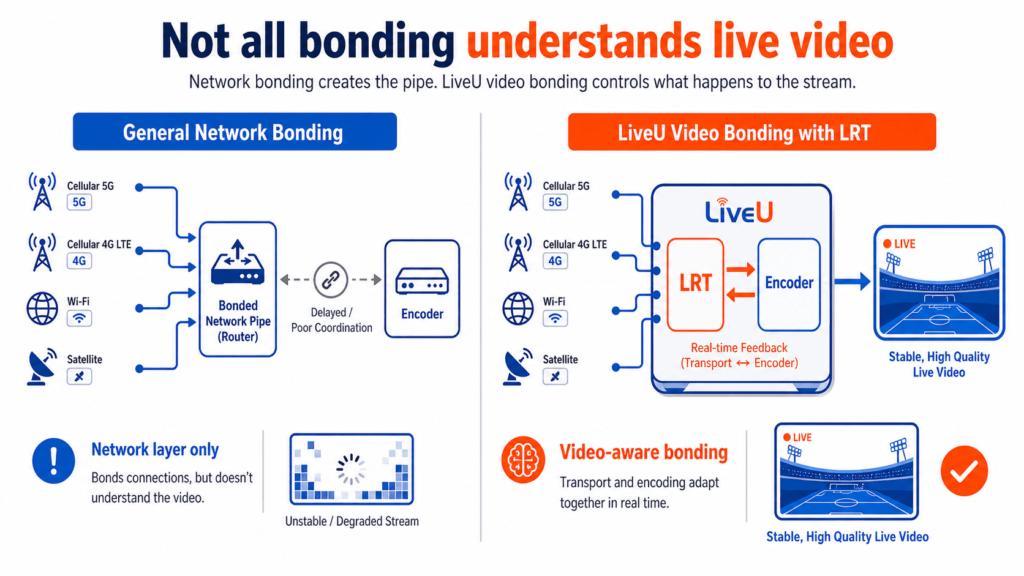
A general-purpose router treats a video stream the same way it treats an email, a file download, or a video call. It just moves data. The video encoder – the device actually creating your video – is a completely separate piece of equipment sitting on top of the router. The two don’t talk to each other.
So What Happens When the Network Gets Rough?
Here’s where the problem shows up.
Imagine you’re live on air. One of your cellular connections suddenly drops – maybe you drove under a bridge, or the crowd around you saturated the local tower. Your router detects the issue and starts rerouting traffic. But your encoder has no idea any of this is happening. It’s still trying to push the same bitrate it was pushing a second ago.
By the time the encoder figures out something is wrong, it’s too late. Frames have dropped. Artifacts have appeared on screen. Your broadcast has glitched.
The router and the encoder are like two people in different rooms trying to coordinate without a phone.
How LiveU’s Video Bonding Works: LRT Explained
LiveU was built from day one for one job: live video over cellular. And the way it approaches bonding reflects that completely.
In a LiveU unit, the encoder and the transport are the same system. They’re not two separate devices talking over a cable. They’re one integrated system with a shared brain.
That shared brain is called LRT™ – LiveU Reliable Transport. It’s the protocol LiveU invented and patented, and it sits at the heart of every unit we make. The key thing about LRT is this: it is video-aware.
LRT does four things simultaneously, all the time:
| LRT Pillar | What It Does | Why It Matters for Video |
|---|---|---|
| Packet Ordering | Numbers and reorders packets that arrive out of sequence across multiple connections | Without this, bonded connections produce visible glitches and frame errors |
| Dynamic Forward Error Correction | Adds just enough redundant data to recover from packet loss – automatically adjusting based on network conditions | Recovers from data loss before it reaches the viewer |
| Acknowledge & Resend | Flags missing packets and requests retransmission efficiently, without heavy overhead | Fixes gaps cleanly without adding noticeable delay |
| Adaptive Bitrate Encoding | When bandwidth drops, LRT tells the encoder directly – immediately – to lower bitrate | The encoder reacts before frames are lost, not after |
Network Bonding vs. Video Bonding: Where the Real Difference Is
A general-purpose bonding router bonds at the network layer. It creates a pipe and hands it off. The encoder sits above it, blind to what’s happening below.
LiveU bonds at the video layer. The encoding and the transport decisions happen together, continuously. The transport engine and the encoder are in a constant, real-time conversation.
What This Looks Like in Practice
Two scenarios, same bad network:
Scenario A – General-purpose bonding + external encoder:
- Network drops. Router starts rerouting.
- Encoder doesn’t know. Keeps pushing same bitrate.
- Frames drop. Artifacts appear. Broadcast glitches.
- Encoder eventually detects the problem and adjusts. Seconds too late.
Scenario B – LiveU:
- Network drops. LRT detects it immediately.
- LRT signals the encoder directly – in real time.
- Encoder lowers bitrate before frames are lost.
- Network recovers. LRT signals the encoder to push quality back up.
- Viewer sees nothing. Broadcast continues clean.
The Bottom Line
General-purpose network bonding tools are excellent at what they do. If you need robust, reliable internet connectivity in the field, they are a smart and cost-effective choice. But they were not designed for the specific demands of live broadcast video – where a half-second of glitching on a live news shot or a sports final is not recoverable.
LiveU was built for exactly that. The encoder, the bonding, the error correction, and the adaptive logic are all one system, purpose-built around the demands of live video.
When your broadcast has to go out clean, every time, the difference between “internet bonding” and “video bonding” is the difference between hoping for the best and engineering for the worst.
More than 5,000 organizations worldwide – across news, sports, public safety, and professional AV – rely on LiveU and LRT to deliver live video every day. They didn’t get there by hoping a general internet solution would be good enough. They got there by choosing a system where the bonding and the video speak the same language.
If you’re ready to make that same call, we’d love to talk.
FAQs
A: The encoder keeps pushing the same bitrate even as the network deteriorates – because it has no way of knowing things have changed. By the time it detects a problem on its own, frames have already dropped and artifacts have already appeared. The reaction comes after the damage, not before. With an integrated system like LiveU, the transport layer and the encoder respond together, in real time, before the viewer sees anything.
A: Bonding gives you a bigger, more resilient pipe – and that’s valuable. But live video needs more than a reliable pipe. It needs packets to arrive in the right order, errors to be corrected on the fly, and the bitrate to adjust the moment conditions change. Bonding handles the connection. LRT handles everything the video itself needs on top of that.
A: The opposite, actually. Because LRT adjusts proactively – before bandwidth is fully lost – the changes are small and gradual rather than sudden. The viewer experiences a consistently watchable stream rather than a clean picture that suddenly freezes or glitches. Small, smooth adjustments beat big, reactive ones every time.
A: It applies to anyone who is live and can’t afford for it to go wrong. LiveU is used by solo creators, YouTubers, IRL streamers, one-person news crews, houses of worship, and independent producers – as well as the world’s largest broadcasters and sports networks. The common thread isn’t the size of the production. It’s the fact that the moment is live, and live moments are unrecoverable. If reliable video matters to you, the tool you use to transmit it matters too.