



Public Safety Mission Ready Series:
Q&A Guide #2
From the Frontline to Command: Operationalizing LiveU for Public Safety & Infrastructure
Welcome to Part 2 of our Public Safety Q&A series. In Part 1, we examined the foundation of mission-critical connectivity and field resiliency. Here, we shift focus to real-world execution and explore how public safety agencies, utility operators, and emergency management teams deploy LiveU solutions across active operations, tactical missions, and cross-agency responses.
Q: How does LiveU support Law Enforcement & Tactical Operations?
During dynamic tactical operations and daily patrol, modern law enforcement agencies rely on LiveU to deliver secure, mission-critical visual intelligence directly from the frontline to command. By deploying ruggedized field units like the LU-REQON1™, teams capture sub-second, low-latency video from interior and exterior drones, patrol vehicles, helicopters and a variety of tools used by SWAT entry teams. Patented LRT™ bonding technology combines cellular, Wi-Fi, and satellite networks into a resilient stream, ensuring feeds remain stable and connected even in remote areas or congested networks. With LiveU Video Return and LiveU Matrix, control rooms and Real-Time Crime Centers (RTCCs) can push those live perspectives back out to officers’ mobile devices or share them securely with partner agencies in a mutual aid scenario, providing a single COP. When critical incidents unfold rapidly, Public Information Officers leverage LiveU Studio to produce cloud-based briefings and press updates on the fly, while field teams use FileBridge and IP Pipe to transfer high-res mapping data or remotely control specialized cameras without leaving the scene.
Q: How does LiveU support Real-Time Crime Centers (RTCC)?
LiveU provides reliable transport of low-latency video from vehicle dash cams, tactical SWAT units, and interior/exterior drones directly into RTCC systems. LiveU’s plug-and-play field units enable swift setup in any location, integrating seamlessly with existing video management systems and supporting both HDMI and IP devices. For agencies managing large events or tactical operations, this technology is capable of providing encrypted video delivery with remote PTZ camera control.
At the heart of the solution is LiveU Reliable Transport protocol (LRT™), which combines multiple cellular networks to ensure uninterrupted connectivity, even in challenging environments. The patented highly resilient IP-video protocol permits LiveU solutions to transmit high-quality video and sensor data wirelessly, making them highly portable.
By bonding, or combining several diverse IP connections, including 4G and 5G mobile connections, Low Earth Orbit satellite (LEO), Mesh Radio, WiFi and Ethernet, into a single, secure and robust connection, the LiveU Situational Awareness Solution, backed by LRT, can be deployed in remote locations or areas experiencing network congestion.
LiveU Central, our cloud management platform, seamlessly ties in with RTCC platforms: Fusus, Milestone, and Genetec) to deliver these feeds.
During active standoffs or warrant executions, command can use LiveU Video Return to push live feeds back to entry teams’ mobile devices or field monitors, providing identical situational awareness to both command and operators on the ground.
Q: How is LiveU applied in Critical Infrastructure, Power Grids, and Utilities?
For departments of transportation (DOT), utilities, power grids, pipelines, and transportation corridors, LiveU provides real-time video for SCADA, GIS, and EMS systems. Field teams can perform drone inspections and upload massive 3D mapping datasets via FileBridge without leaving the site, eliminating unnecessary travel back to headquarters. Features such as LiveU’s IP Pipe allow for remote access and control of IP-based equipment like PTZ cameras at isolated sites. Precise GPS location tracking on units allows agencies to know exactly where crews, inspections, and assessed damage zones are located.
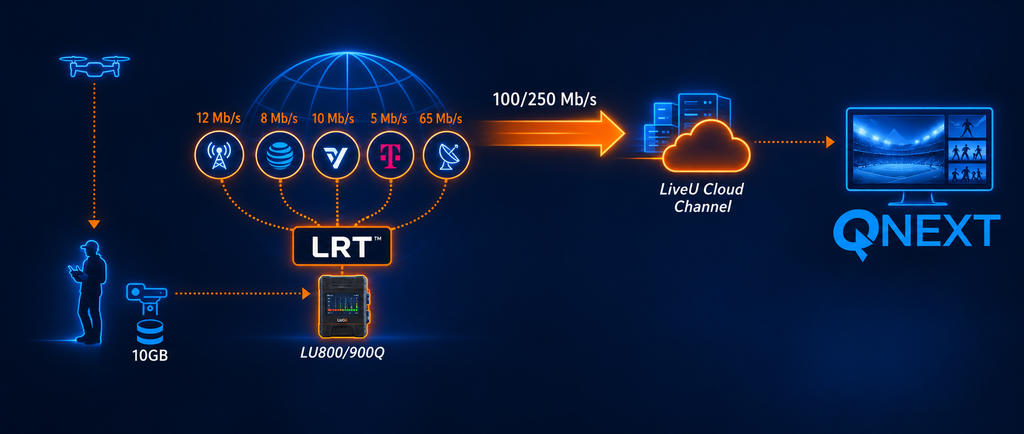
LiveU provides both bonded internet hotspots and file-based workflows to help meet your needs no matter the demands of the location where you’re setting up. In the typical scenario, information flows from the drone to the command center to help make the right calls in the moment.
Q: How does LiveU operate in Search & Rescue and Emergency Management?
During natural disasters – floods, wildfires, hurricanes – LiveU units pre-positioned in mobile command vehicles establish connectivity within minutes of arrival on scene, without waiting for fixed infrastructure to come back online.
Connectivity that survives when networks don’t. LiveU’s core technology, LRT™ (LiveU Reliable Transport), bonds multiple network types together in real time – cellular, WiFi, Ethernet, and satellite (SATCOM) – so a single dropped or congested connection doesn’t take the feed down with it. This SATCOM integration matters most in the scenarios emergency managers dread: when cell towers are damaged, overloaded, or simply don’t reach the terrain. In one recent example, the Fire Rescue Service of the Czech Republic deployed LiveU units that bonded 5G, LTE, WiFi, and Starlink satellite connectivity during a large-scale wildfire response involving over 2,500 firefighters and multiple aircraft – maintaining continuous video to their National Operational Center even as ground conditions and network availability shifted by the hour. The agency credited the shift from radio-only communication to real-time video with shortening response time and sharpening command decisions.
GPS tracking for asset accountability. LiveU encoders carry built-in GPS location tracking, which does two jobs at once. On a map view (through LiveU Central), dispatchers and incident commanders can see exactly where every deployed unit is – which translates directly to knowing where personnel and equipment are physically located across a disaster zone. That’s a basic but often-missing piece of situational awareness in fast-moving, multi-agency operations: knowing not just what a team is seeing, but where they are right now. At the same time, those same encoders are streaming live aerial or ground footage, so command centers get positional accountability and visual intelligence from the same device.
Data and file transfer in the field. Two often-overlooked LiveU capabilities extend past live video streaming. DataBridge turns a LiveU unit into a bonded internet hub, giving field teams reliable access to mapping tools, ATAK-style situational awareness apps, and other mission-critical platforms even where fixed internet is degraded or gone. FileBridge (LiveU’s file transfer capability) lets teams send large files – photos, documents, damage assessments – back to command instantly, which matters most in the recovery phase, when the priority shifts from live video to getting documentation and data into the hands of people making resource-allocation decisions.
Similar principles played out during humanitarian response to the 2020 Beirut port explosion, where a French search-and-rescue organization used a lightweight LiveU unit to relay live drone footage from the disaster site, letting responders assess conditions from a safe distance before committing personnel.
Q: How does LiveU enhance public communication and PIO (Public Information Officer) operations?
Using LiveU Studio, PIOs can produce broadcast-quality press conferences, emergency updates, and public safety advisories directly in the cloud. It supports multi-camera switching, graphics overlays, lower-third titles, and remote guest caller integration (e.g., Teams/Zoom) for rapid public dissemination.
Q: Can you share real-world examples of agencies using LiveU in the field?
LA Fire, LA PD, Metropolitan Police Department of the District of Columbia (DC Metro), Florida Department of Transportation (FDOT) have used LiveU for both public affairs and mission-critical operations. In natural disasters, the various agencies utilize LiveU portable field encoders to maintain reliable video communication with first responders. The LiveU units operated seamlessly in remote areas where standard cellular infrastructure was compromised, sending real-time aerial drone feeds and ground video to the command center.
There are many more examples of LiveU used in various applications. We can’t wait to share more success stories!
Ready to modernize your agency’s visual intelligence workflow?
Every mission environment presents unique connectivity challenges. Contact our dedicated Public Safety team today to discuss your operational needs, schedule a live field demo, or learn how LiveU can integrate with your existing RTCC and command center software.