


Story-Centric, Not Slot-Centric: Rethinking the Live Signal for Digital-First Production
First published in The Broadcast Bridge
I spent over a decade working in live news and media production, and I’ve seen a shift in the answer to: what does “going live” actually mean to you? Ten years ago, the answer was boring in the best possible way. A truck, a signal, a slot on the rundown. Ask a broadcast or digital team for the same thing today and no two answers line up. A vertical clip for the phone… A full-length stream for OTT… A clean multi-cam feed for a rights partner… Same events, same crews, with every one of those deliverables expected within minutes of the others.
That usually gets filed under content strategy. I’d argue it’s an engineering problem, and most of the engineers I talk to are still trying to solve it with plumbing designed for a world where “live” meant one signal going to one place at one time.
The Slot Is Gone. The Signal Has to Work Harder.
Linear broadcast was engineered around the slot: a fixed destination, a fixed time, and a fixed chain running from camera to transmitter to living room. Digital-first content breaks all of that at once. The importance of the slot has diminished, and content has to move around the clock. There’s no single destination either. The same live moment needs to land on a dozen platforms, each with its own format and spec sheet. And the old luxury of a dedicated encoder per stream is mostly gone. One crew, one field kit, and one connectivity path now must cover what used to take three separate setups.
When I sit down with an assignment desk, a director of digital, and a sports producer, I’ll hear the same general ideas: more platforms, the same or fewer people, and no more hours in the day. That’s the real pressure behind “digital-first.” While posting to social is a small part of the strategy, the real benefit is in making the workflows more efficient without piling on headcount or complexity.
From Slot-Centric to Story-Centric
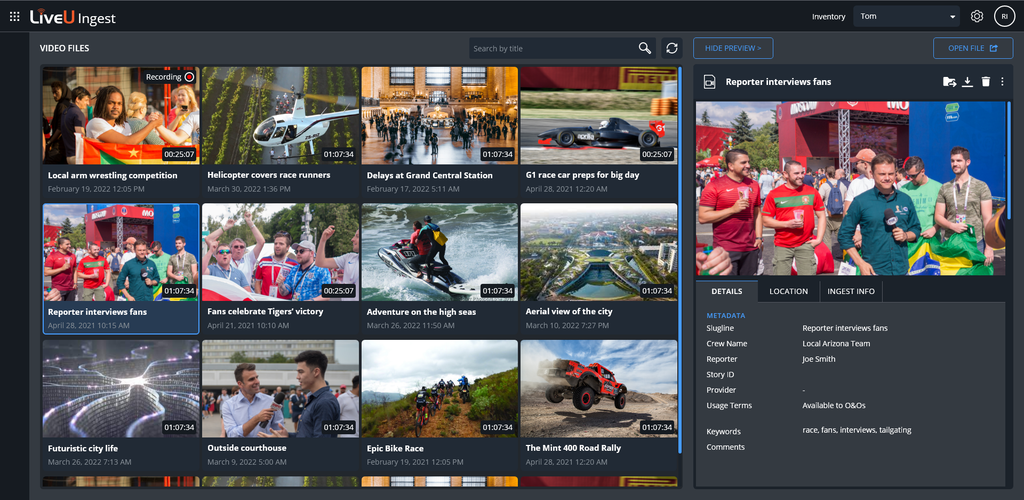
The engineering answer is a change in what you build for. In a slot-centric workflow, you engineer the live signal for one destination: a channel, a slot, a single output chain. In a story-centric workflow, you treat that signal as an asset from the second it’s captured. It’s one clean feed that can be tagged, split, recorded, and pushed to multiple destinations at once, without re-engineering the chain for each one.
For example, let’s say there’s a cat stuck in a tree. The producer adds that story to their 9AM rundown, and every future show and digital story is able to pull from the same story assets. The photographer attaches their live feed of the cat being rescued to the story with a touch of a button. The editors and producers can see all of the footage from the story in one place, so they can more efficiently use it for future extensions of the story.
The real shift is where the engineering effort goes. Design slot-centric and you optimize for the destination. Design story-centric and you optimize for the source. If the originating signal isn’t clean, resilient, and structured for multi-path distribution from the start, every destination downstream inherits the same weakness.
So, in most conversations I have with teams making this move, we end up in the same place: the field unit.
Why the Intelligence Has to Start at the Point of Capture
Every story-centric workflow quietly assumes one thing: that the signal coming in from the field is stable. Traditionally, that may be a challenge with crowded venues, moving vehicles, remote sites, and cellular networks buckling under load. If the connectivity layer can’t adapt in real time, all that elegant downstream infrastructure (tagging, routing, simultaneous distribution) has nothing solid to stand on.
That’s the problem AI-driven connectivity management exists to solve, and it’s why we built LIQ (LiveU IQ) natively into our newest field encoder, the LU900Q, instead of bolting connectivity on as an afterthought. LIQ continuously reads real-time and historical cellular data (signal strength, congestion, carrier performance) and actively manages bonded modems across up to 11 connections, six of them internal 5G MIMO, adjusting as conditions shift mid-broadcast. Static bonding, by contrast, just combines whatever paths it can see.
In short, we are always looking for the best available provider for each of your modems, rather than “wasting” connections that aren’t pulling their own weight.
Anyone who’s produced out of a sold-out stadium knows exactly what happens to local cellular the moment tens of thousands of fans use their phones at once. That’s the precise condition where static bonding falls apart and dynamic, AI-driven bonding is built to hold. It shifts load off saturated paths in real time instead of waiting for a dropout and reacting after the fact.
The rest of the spec follows the same logic: flexibility can’t come at the expense of reliability. The LU900Q runs dual-camera workflows across SDI, HDMI, USB, and IP inputs, up to 4K with 4:2:2 10-bit HDR encoding and as many as 32 audio channels. That’s real headroom for genuinely complex multi-cam, not just single-camera ENG. Dual video return and dual intercom push studio-level coordination all the way out to the field crew, which is a real change for a reporter who used to be flying blind between hit and toss. That’s program AND prompter for them! But none of that means anything if the connectivity underneath won’t hold, and that’s the whole argument for building the intelligence in natively rather than layering it on top.
Closing the Loop: From Capture to Cloud
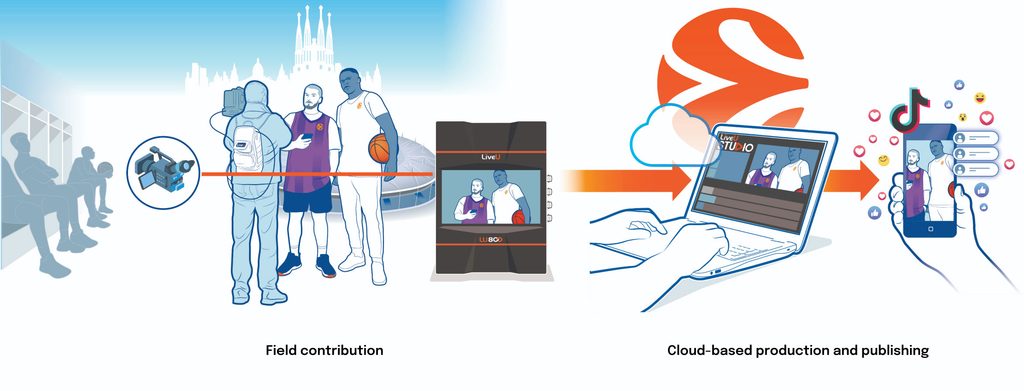
A resilient field signal is only half of story-centric workflows. The other half is what happens to that signal once it lands. A clean, stable feed doesn’t buy you much if a person still must ingest, log, and re-route it by hand for every destination.
We’ve watched this play out at scale. For EuroLeague Basketball’s Rivalry Series, content teams ran LU800 (also featuring LIQ) field units into LiveU Studio to grab behind-the-scenes footage from arenas across multiple cities and produce it centrally out of Barcelona. One signal, multiple outputs, no duplicate field crews for each platform. ITV pulled off a version of the same thing in a completely different genre. As Love Island leaned harder into a digital-first strategy, a low-latency return feed and two field units fed a cloud production platform to build a synchronized picture-in-picture stream for a second, digital-only show. That’s the kind of output that would have demanded an entire second physical production chain a few years ago.
Same pattern both times: capture once, structure the signal for multiple destinations at the source, and let the cloud layer handle the routing instead of a person doing it by hand for each platform.
What This Means for the Engineers Doing the Evaluating
If you’re the one speccing field-to-cloud architecture for a digital-first move, a handful of questions are worth asking of any vendor, including us:
- How many independent bonding paths does the field unit actually manage, and does it reason about them in real time or just aggregate them statically?
- Does the connectivity layer degrade gracefully under congestion, or does it need a human to notice and step in?
- Can the signal be structured for multi-destination routing at the point of capture, or does that still happen downstream, by hand?
- Does adopting it stand up a parallel infrastructure stack, or does it extend what you’re already running?
That last one carries more weight than it looks. Most of the teams I work with aren’t looking to rip out infrastructure that works. They want to stretch it to cover destinations it was never built for.
Digital-first production is enhanced by thinking about where you spend your engineering effort. As I see it, the focus should be as far upstream as you can push it. A story-centric workflow is only as reliable as the signal it starts with, and that signal is only as reliable as the connectivity intelligence holding it together in the field, in real time, under conditions nobody can fully predict in advance. That’s the part worth obsessing over: the one point in the whole chain where you have the least control and the most to lose.
Ben Ratner is a Solution Sales Specialist at LiveU and an Emmy-winning producer who spends most of his days in direct conversation with news, sports, and Pro AV teams working through the shift to digital-first production.