




The Missing Half of Cloud Sports Production
TL;DR
There’s a gap in how cloud sports production is usually sold, and it tends to show up at the worst possible moment: an hour before kick-off, at a venue with congested WiFi, when the stream that worked in testing starts to jitter, buffer, and drop frames.
Cloud production platforms have transformed live sports, with browser-based switching, remote graphics, and multi-destination distribution, all without a physical control room. But they share one quiet assumption: that a reliable, broadcast-quality signal is already arriving from the field. For many tier 2/3 leagues, college athletic departments, clubs, and small production companies, that’s the assumption that breaks.
What Lightweight Sports Production Actually Means
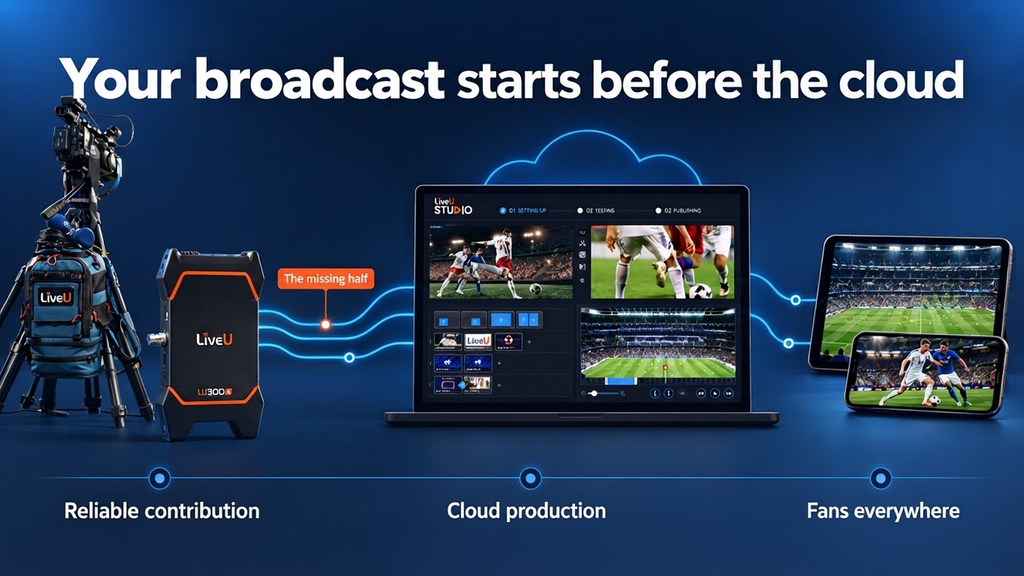
Lightweight sports production delivers live sports with a fraction of the on-site footprint of a traditional broadcast. Instead of an OB truck, a satellite uplink, and a full crew at every venue, it connects three pieces into one workflow:
- Capture: portable field encoders that transmit live video from the venue over bonded cellular and IP connections.
- Create: a cloud production platform for switching, graphics, replay, and recording in a browser.
- Distribute: delivery straight to streaming platforms, apps, and social channels.
“Lightweight” describes the footprint, not the output: a professional, multi-camera broadcast produced by a small team, often a single operator. The key word is “connects.” Many solutions on the market sell only the middle piece.
Two Problems Disguised as One
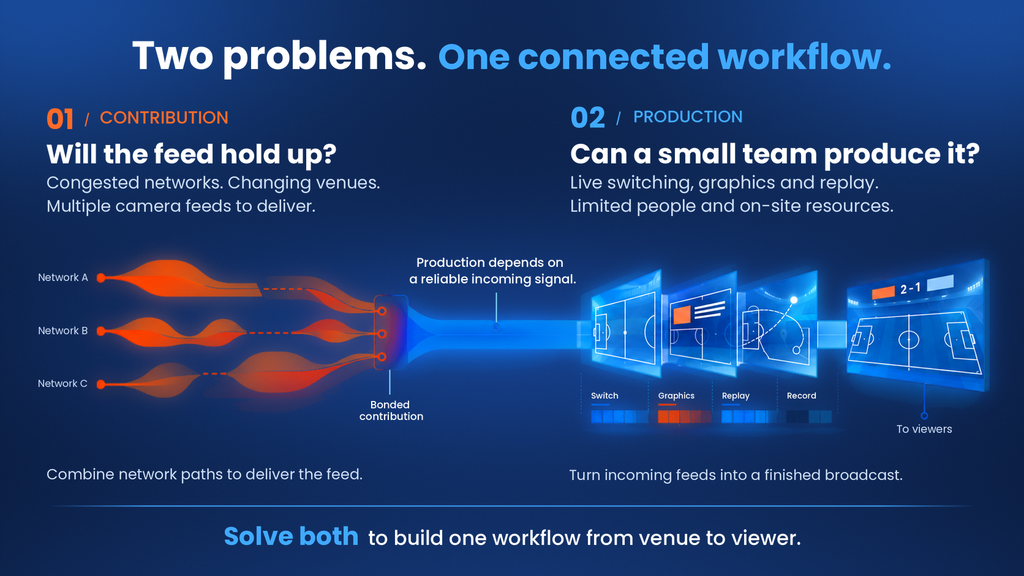
Every live sports broadcast has to solve two problems:
- Contribution: getting broadcast-quality video from the venue to the cloud, reliably and with low latency, over whatever network is available that day.
- Production: turning that signal into a finished broadcast with switching, graphics, audio, and distribution.
Cloud production platforms solve the second problem. They start working only once a clean signal arrives.
Picture game day at a college athletic department. The production platform works perfectly in testing. At the venue, a crowd of fans on their phones competes for the same cellular bandwidth, and a standard encoder on a single connection starts dropping frames. Latency builds before the signal even reaches the platform. Then the stream drops at the worst possible moment: the goal, the buzzer-beater, the play everyone came to watch.
The production platform isn’t at fault. It was never designed to solve contribution. But for the fans watching the stream collapse, that distinction doesn’t matter.
Why the Encoder Matters, and Where the Seam Breaks
It’s tempting to treat field contribution as a solved problem: pick an encoder that outputs SRT, point it at the platform, and move on. But contribution from a live venue is demanding in ways that have nothing to do with the camera or the production platform. Crowded venues are tough RF environments, where every phone in the stands competes for the same frequencies and a single connection rarely holds up. Professional encoders bond multiple cellular connections across operators to keep the uplink stable, with error correction built for real-time delivery and frame-accurate sync across cameras.
Even with professional hardware sourced separately, a second problem appears: the seam. Connecting one vendor’s encoder to another vendor’s platform takes protocol tuning, latency calibration, and re-validation after every update. And when something fails during a live event, there are two support lines to call and two vendors pointing at each other.
What a Connected Workflow Actually Means
LiveU Lightweight Sports Production removes the seam by building both sides of the workflow as one system.
In the field, LiveU encoders, including the LU300S, LU800, and LU900Q, bond multiple cellular and IP connections into one stable uplink, built for live video over unpredictable networks. LiveU IQ takes this a step further. Instead of being tied to a fixed set of mobile operators, the encoder automatically switches to the best-performing networks at each location, based on real-time monitoring and years of cellular performance data from venues worldwide.
In the cloud, LiveU Studio receives the signal from LiveU encoders natively, with no protocol translation and no compatibility gap. It provides multi-camera switching, graphics, instant replay, ISO recording, dynamic ad insertion, and distribution to up to 30 destinations at once.
A connected workflow means one vendor and one support line from the camera to the viewer. Here’s how the two approaches compare:
| Feature | Production platform only | Encoder + cloud production |
|---|---|---|
| Field contribution | Not included. You source and configure your own encoder | Included. Portable LiveU encoders built for live sports |
| Connectivity at the venue | Depends on the encoder you choose, often a single connection | Bonded cellular and wired connections, with LiveU IQ switching to the best-performing mobile operators |
| Transport into the cloud | Usually SRT or RTMP from a third-party device | Native connection from LiveU encoders into LiveU Studio |
| Multi-camera sync | Depends on matching encoder and platform settings | Up to four frame-synced cameras |
| Production tools | Professional browser-based toolset: switching, graphics, replay, ISO recording, and multi-destination distribution | The same professional toolset in LiveU Studio, connected natively to the encoders in the field |
| Game-day support | Two vendors, two support lines | One vendor accountable for the whole chain |
| Cost visibility | Platform fee only; contribution and integration costs come later | One affordable fee covering encoder, data, and production |
The Events You’re Not Covering Yet
Reliability is the first payoff of an integrated workflow. The second is reach. Without a truck, a traveling crew, and a separate contribution setup, lower-profile sports, early rounds, and smaller competitions become realistic to produce.
Each new event is new content for fans and new inventory for sponsors, distributed to a league’s app, team channels, and partners in parallel. For athletic departments, that means more sports on stream without more headcount. For leagues and clubs, it means more value from media rights and more fans reached beyond the stadium.
Proof Points: EuroLeague, PSG and Free Ligue 1
EuroLeague Basketball. For the 2025–26 season, EuroLeague ran TikTok LIVE shows around its biggest games, including an El Clásico show that moved through Barcelona’s streets and into the arena. An LU800 sent the live shots to LiveU Studio, where a remote editor added graphics, published to TikTok, and clipped highlights for other channels.
Paris Saint-Germain. To stream a PSG Qatar Tour match in three languages across multiple platforms, LiveU field units sent a main and a backup feed for each language into LiveU Studio, which switched automatically if a feed dropped.
Free Ligue 1. 714 Production uses LU300S encoders at Ligue 1 stadiums to send live content to its Paris control room, where it’s produced in LiveU Studio for the Free Ligue 1 app and its more than three million users. No satellite uplink, no truck, no on-site control room.
The Question Worth Asking
A production-only subscription looks cheaper on paper, until you add contribution hardware, integration work, and two vendors to manage. LiveU Lightweight Sports Production comes as a single, affordable fee that covers the encoder, data, and production.
Before evaluating any cloud production solution, ask one question:
What do I need to buy or set up separately to get a reliable, multi-camera signal from my venue into this platform?
If the answer is “you’ll need to figure that out,” you’re looking at a production tool, not a production workflow.
Want to see what this costs for your event schedule?
Use the cost calculator
Go deeper: read the Lightweight Sports Production whitepaper
Prefer to talk it through? Book a demo
Frequently Asked Questions
A cloud production platform handles switching, graphics, replay, and distribution. Lightweight sports production is the full workflow around it, including the field encoders that get a reliable signal from the venue to the cloud in the first place.
Far fewer than a traditional broadcast. Camera operators at the venue send feeds to the cloud, and a single operator can switch cameras, add graphics, and run replays from a browser, from anywhere.
Events that matter to fans but can’t justify a full broadcast: lower-profile sports, early tournament rounds, youth and semi-pro competitions, and venues with no broadcast infrastructure. For production companies, it makes smaller events profitable to take on.