




The Newsroom Is Going Digital-First. Is Your Workflow Keeping Up?
Key Takeaway
Primetime is all the time
The 10 o’clock news is no longer “primetime.” That’s not a criticism of broadcast; it’s a description of a fundamental change in how and when audiences consume news. The story that breaks at 2:47 p.m. isn’t held back for the primetime slot anymore. It lives on TikTok before a reporter has filed a script, on YouTube before the photographer has offloaded the SD card, or on three regional OTT platforms before anyone has checked the live feed routing. The audiences your organization needs to reach, particularly Gen Z and Millennials, who according to Deloitte’s 2025 Digital Media Trends survey find social media content more relevant than traditional TV shows at rates of 56% and 43% respectively, are watching now, wherever they happen to be.
Digital-first means the story is designed for digital platforms from the start – not adapted for them after the broadcast version is done.
Which raises the question that every news director, director of digital, and director of operations should be asking right now: is your workflow built for that world?
The New Reality: No Time Slots, No Single Destination, No Margin for Slow
The old model was clean. You had a slot. You had a channel. You had a team built around meeting that slot, on that channel, reliably.
The new model is something else entirely. A single story now needs to reach vertical video for Instagram Reels and TikTok, horizontal for broadcast and YouTube, a clipped highlight for X, a standalone stream for your OTT app, and a packaged segment for linear – often simultaneously and within minutes of the event occurring.
According to the Reuters Institute’s 2026 Trends and Predictions report, newsrooms are increasingly trying to get their staff to function like content creators who are versatile and can produce content across different formats and platforms. The typical multimedia journalist today is expected to report, write, shoot, edit, optimize, and publish across multiple channels – often solo.
And that expectation exists against a backdrop of shrinking teams. Entertainment and media companies cut more than 17,000 jobs in 2025 alone – an 18% increase from 2024, according to Challenger, Gray & Christmas (as republished by The Wrap). News organizations accounted for more than 2,000 of those cuts. The people who left took institutional knowledge, established workflows, and years of broadcast experience with them.
The teams that remain are younger, less experienced, and are being asked to do more across more platforms than anyone in this industry has ever been asked to do.
Why Being First Matters More Than Ever – And Why Most Teams Are Still Losing Time
Here is a question worth sitting with: in your newsroom, who publishes first: digital or broadcast?
In most newsrooms I’ve spoken with, the honest answer is often: broadcast. Not because anyone designed it that way, but because the workflow was built around broadcast first. Digital is the adaptation. The add-on. The thing that happens after the real work is done.
That structure made sense when digital was a supplement. It makes no sense when digital is the primary destination.
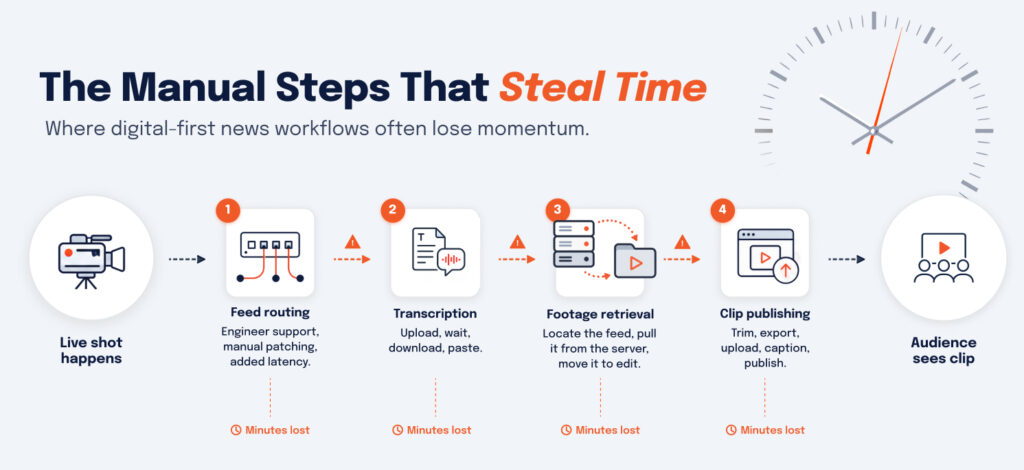
The manual steps that steal time:
- Footage retrieval: A live shot happens. The feed comes in. Someone has to locate it, pull it from the server, move it to an edit station, and wait for the transfer. Minutes pass. Sometimes, many minutes.
- Transcription: Producers need to know what was said before they can write a script, cue a clip, or file a web article. Most teams still stop the workflow, upload to a third-party tool, wait, download, and paste.
- Feed routing: Getting an IP feed or a Zoom call or a social stream into a broadcast workflow typically means an engineer, a scan converter, and a manual patch. Or a workaround that introduces latency and quality loss.
- Clip publishing: Someone trims the clip, exports it, logs into the platform, writes the caption, uploads, waits for processing, schedules.
None of these steps are technically complex. All of them are manual. All of them introduce lag. And in aggregate, they are the difference between being first and being third.
What Does “Digital-First” Actually Mean in a Newsroom Context?
There is a difference between a newsroom that publishes to digital platforms and a newsroom that is designed around digital platforms from the start. Publishing to digital is still the dominant model: story breaks, broadcast covers it, digital team adapts it, social team posts it. The story is designed for broadcast. Digital gets the adaptation.
Designing for digital means the story planning begins with the question: where is this audience, and what does it need? The broadcast version, when it airs, is one output of a workflow that has already been serving Instagram, YouTube, OTT, and your app. The clip is already cut. The transcription is already done. The feed is already distributed.
This is not hypothetical. It’s the operating model that organizations like ITV have already deployed for properties like Love Island, where a live podcast was simultaneously streamed to ITVX and YouTube at the same time as the main broadcast using LiveU – not as an afterthought, but as a designed workflow from day one.
The question isn’t whether your newsroom needs to get there. It does. The question is what’s standing between where you are now and a workflow that actually supports it.
Accelerating Content When the Workflow Is Working
It’s not about volume; it’s about the speed at which a story moves from capture to audience, across every platform that audience uses.
When the workflow is working, it looks like this:
- Footage arrives in real time: The moment a live shot is up, editors, producers, and the promotions team can access the feed – not after the broadcast, not after a manual transfer. Footage is available as it comes in.
- Transcription runs automatically: The producer who needs to write the web article doesn’t wait. The editor clipping for social doesn’t have to scrub to find the soundbite. The assignment desk can read what was said in real time.
- Feeds route without engineering support: Whether it’s an SRT feed from a field unit, a Zoom call, a live YouTube stream, or a studio camera, the production team can pull any source into any workflow: broadcast, OTT, or social – without a hardware swap or an engineering ticket.
- Distribution happens simultaneously: One production moment pushes to linear, to OTT, to social platforms, to streaming destinations at the same time, not in sequence.
Teams stay small: Because the system is doing the routing, the transcription, the recording, and the distribution orchestration, a smaller team can cover more ground – without running harder.
How Broadcasters Are Already Making This Work
Organizations already running live feeds through LiveU’s field units and cloud infrastructure have found they can extend that same ecosystem to digital – starting with two pieces.
LiveU Nexus acts as a cloud-native universal gateway, bringing in IP and digital sources like SRT feeds, Zoom calls, YouTube streams, social media lives – and routing them directly into broadcast workflows without additional hardware or engineering involvement. For producers who have historically needed to call an engineer to get an IP stream into a production, this removes one of the most common friction points in a digital-heavy workflow.
LiveU Studio allows a single operator to produce fully synced multi-camera events from a browser, with distribution to up to 30 linear and digital platforms simultaneously. For digital producers who are being asked to produce at broadcast quality without broadcast infrastructure, this is the gap it closes.
LiveU Record automatically captures all live content fed through the LiveU EcoSystem. Because it is cloud and browser-based, it streamlines production workflows and fosters greater collaboration from anywhere.
One example worth mentioning: One regional news team was deep into evaluating a popular recording-based remote workflow tool when they were shown what the full LiveU EcoSystem could do across live production, distribution, and digital workflow integration. They moved forward with LiveU instead. The decision was based on leveraging a single integrated workflow to serve both broadcast and digital without building two parallel systems – and without the cost and complexity of running them side by side.
That’s the direction the industry is moving. Not two parallel stacks – one for broadcast, one for digital. But instead, a unified ecosystem that serves both from the same infrastructure.
Questions Worth Asking About Your Own Workflow
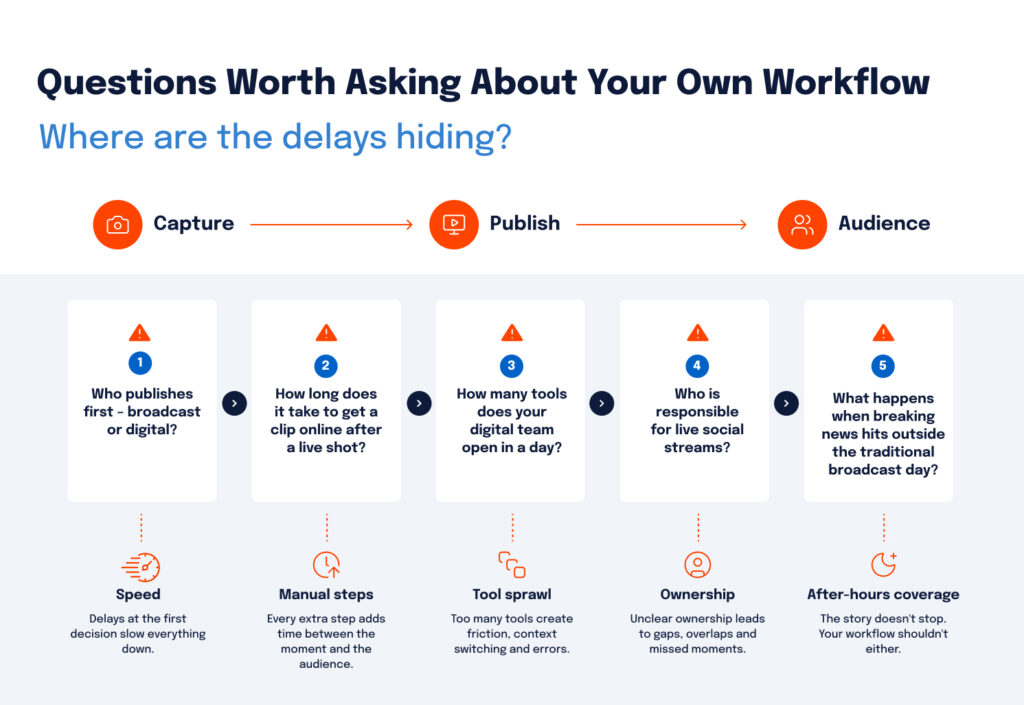
If you’re a news director, director of digital, or director of operations, these questions will quickly reveal where your team is getting stuck:
- Who publishes first – broadcast or digital? If your digital team is consistently publishing after broadcast, the workflow is not designed for digital speed
- How long does it take to get a clip online after a live shot? If the answer involves manual steps: export, upload, platform login, caption, publish – measure that time honestly
- How many tools does your digital team open in a day? Each additional tool is a context switch, a login, a potential breakage point. The best workflows consolidate, not multiply.
- Who is responsible for live social streams? If nobody can clearly answer this, or if the answer involves a workaround, there is a crack in the system
- What happens when breaking news hits outside the traditional broadcast day? If your digital workflow depends on broadcast infrastructure that isn’t staffed, you have a gap.
The answers usually reveal where the manual steps are hiding – and those manual steps are almost always the thing slowing your team down.
The Real Competitive Advantage Is Speed, Not Scale
Some of the most effective digital news operations are running lean teams with tight, automated workflows. The advantage isn’t headcount. It’s how fast a story can move from the field to every platform your audience uses – without someone manually carrying it at every step.
The question is no longer whether newsrooms need to operate this way. They do. The question is whether the infrastructure and the workflows are built to support it.
Learn more about how LiveU’s EcoSystem supports digital-first news workflows at liveu.tv/solutions/broadcast/digital-evolution.
FAQs
No – and this is probably the most common misconception worth addressing directly. Digital-first is a workflow design philosophy, not an editorial hierarchy. It means the workflow is built so that every output – linear broadcast included – is produced simultaneously from the same infrastructure, rather than in sequence. Linear doesn’t lose priority. It simply stops being the single point around which everything else is organized. For most newsrooms, the practical result is that broadcast quality stays the same or improves, because footage, transcription, and feeds are more readily available to everyone on the team – not just the digital desk.
This is one of the most common pain points in newsrooms. Historically, going live to social required either a dedicated encoder operated by an engineer or a consumer tool that trades broadcast quality for simplicity. Neither scales well. Cloud-native production platforms like LiveU Studio are closing that gap. The journey: a single producer can switch cameras, manage guests, overlay graphics, and push to multiple destinations simultaneously from a browser, without a control room or engineering support. The key shift is moving the technical complexity off the person and into the platform, so the producer’s job is editorial, not operational.
A social media team is a publishing function. A digital-first workflow is a production architecture. The distinction matters because a social team working downstream of broadcast will always be publishing second with their output depending on footage, clips, and feeds that flow from a broadcast-centered process. A digital-first workflow moves that dependency upstream: footage is available in real-time as it’s captured, feeds route automatically without manual intervention, and distribution to social, OTT, and linear happens simultaneously rather than sequentially. The social team’s job becomes editorial (what to say and when), rather than logistical, which is where most of the delay currently lives.
Less than most organizations expect, particularly for newsrooms that are already inside a broadcast ecosystem. The organizations making this transition most smoothly aren’t replacing their infrastructure – they’re extending it. If live feeds are already flowing through field units and cloud infrastructure trusted for broadcast, routing those same feeds into digital and social workflows is largely a configuration change, not a rip-and-replace. The more significant investment is usually organizational. Establishing clear ownership of digital publishing, training producers on what’s now possible without engineering support, and building the editorial mindset to plan for all platforms from the start of a story, not at the end of a broadcast.