


Why Your Church’s WiFi Is Not Enough:
Key Takeaway
The Congregation Has Changed – and So Has the Service
There are approximately 380,000 to 420,000 houses of worship in the United States.
For most of their history, reaching a congregation meant filling seats. That has changed permanently.
According to Barna Research, 20% of churchgoers in the U.S. now attend exclusively online, and another 26% use a hybrid model – attending some services in person and watching others remotely. A separate survey found that 39% of Protestant churchgoers have watched a livestream service instead of attending in person.
The result: a significant portion of every congregation is now watching on a screen, every single week. As of 2024, 91% of churches were live-streaming their services, according to the State of Church Tech 2024 report. This is not a pandemic habit that faded. It is the new normal of worship. The question is no longer whether to stream – it is whether the stream is good enough to honor the moment.
What Does “Broadcast Quality” Actually Mean?
Many worship teams hear “broadcast quality” and assume it means expensive cameras or a professional crew. That is part of it. But the more important – and more frequently overlooked – piece is the connection that carries the video out of the building.
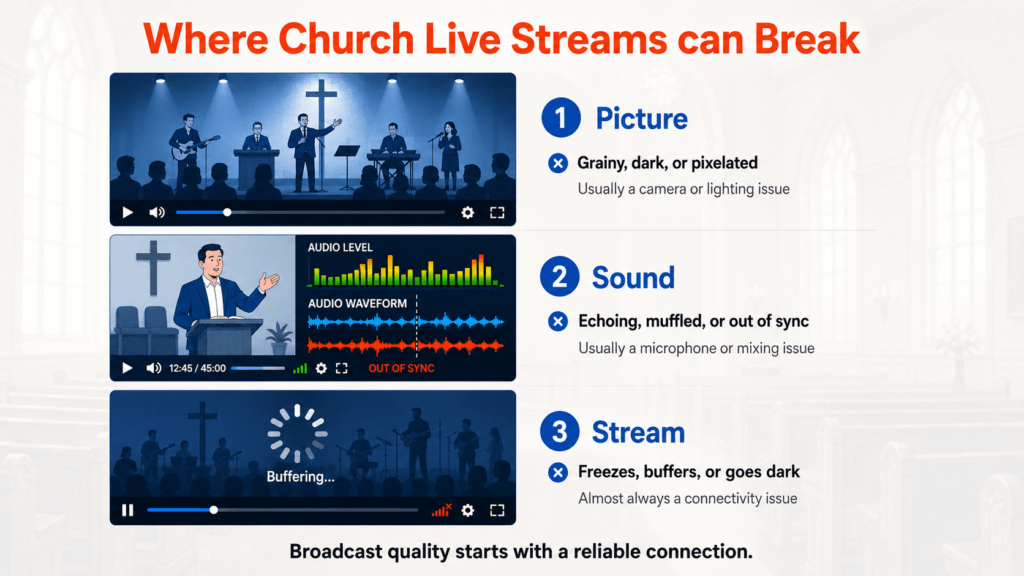
Here is a simple way to think about it. A live stream has three things that can go wrong:
- The picture can look bad. Grainy, dark, or pixelated video. This is usually a camera or lighting issue.
- The sound can be poor. Echoing, muffled, or out-of-sync audio. This is usually a microphone or mixing issue.
- The stream can drop. The video freezes, buffers, or goes dark entirely. This is almost always a connectivity issue.
The first two problems are visible and easy to identify. The third one – connectivity – tends to be invisible until it fails, and it fails at the worst possible times: during a baptism, at the climax of a sermon, in the opening moments of a Christmas Eve service.
Broadcast quality, at its core, means that the third problem never happens.
Why Single-Connection Streaming Fails at the Worst Moment
Most houses of worship stream over the building’s existing WiFi or a single wired internet connection. On a quiet Tuesday morning, that works fine. On Sunday, it is a different story.
When a service begins, every person in the room is also on their phone. They are looking up scripture, sharing the sermon on social media, and just browsing. That shared use competes directly with the stream for the same WiFi bandwidth. The more people attending in person, the worse the connection becomes – exactly when it matters most.
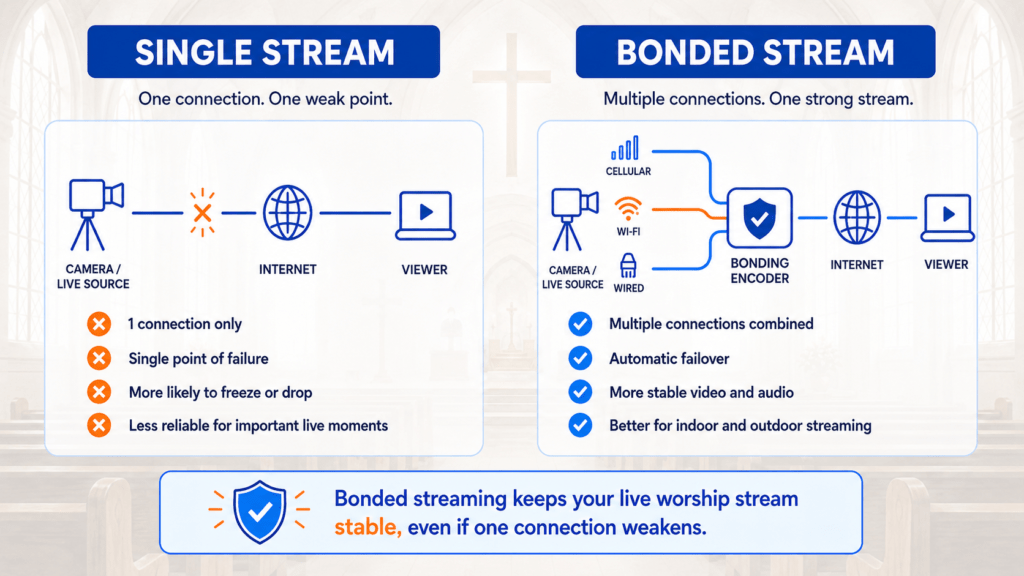
There is also a deeper problem: a single connection is a single point of failure. If your internet provider has an outage, your stream goes with it. If a volunteer unplugs the wrong cable, the stream drops. If the signal weakens for thirty seconds during an outdoor procession, your online congregation sees a frozen screen.
For entertainment content, a brief dropout is annoying. For worship, it is something different. People watching a funeral service for a family member they could not travel to attend, a baptism of a grandchild, or a Christmas morning service from a care facility – they are counting on that stream.
A single connection is not a resilient foundation for that kind of trust.
What Is Bonded Streaming – and Why Does It Matter for Worship?
Bonded streaming solves the reliability problem by combining multiple connections – cellular, WiFi, and wired ethernet – into one unified stream.
Think of it like a highway with multiple lanes. When one lane slows down or closes, traffic shifts to the others and you keep moving. Your stream never notices. Your online congregation never sees a freeze frame.
Inside the sanctuary, a LiveU device can bond the venue’s wired LAN connection, the building’s WiFi, and a few cellular networks simultaneously. This means that even during a standard Sunday service – where a reliable internet connection exists – you are never dependent on a single pipe. If the venue’s internet hiccups for any reason, cellular takes over instantly and automatically.
Outside the walls, where there is no cable drop and no WiFi, the system draws on multiple cellular carriers at once – AT&T, Verizon, T-Mobile – distributing the stream across all of them. If one network is congested or loses signal, the others carry the load without any human intervention.
This matters because meaningful worship happens everywhere. A river baptism, an outdoor Easter service, a graveside memorial – bonded streaming goes where a single connection cannot, and holds where a single connection would fail.
The device that makes this possible is called a bonding encoder. It connects directly to your camera, compresses the video, and sends it simultaneously over multiple connections – cellular, WiFi, and wired – to wherever your stream needs to go. It requires no engineering background to operate, and for most worship setups, it is up and running in minutes.
Real-World Worship Scenarios Where This Changes Everything
Bonded streaming is not just for large productions. Here is what it looks like in practice across the situations worship teams encounter every week.
Sunday main service
A congregation of 800 fills the sanctuary. Another 1,200 are watching online. The in-venue WiFi is under strain from hundreds of phones. A bonding encoder combines the building’s wired connection, WiFi, and cellular simultaneously – ensuring the online audience sees and hears every word clearly, regardless of what is happening on the local network.
Outdoor Easter sunrise service
No cable runs. No venue WiFi. The encoder runs entirely on cellular, drawing from multiple carriers at once and streaming in high definition to congregation members who could not attend – including servicemembers overseas.
Baptism at an off-site location
A river baptism is one of the most meaningful moments in a congregation’s life. Streaming it over a single hotspot risks dropping at exactly the wrong second. Bonded streaming – across cellular, WiFi, or both – makes it as stable as a connection from inside the building.
Multi-campus and multi-site church streaming
A lead pastor delivers a message from the main campus while satellite locations receive the feed live. Any interruption breaks the experience for every location simultaneously. Bonding provides the redundancy that multi-site ministry requires.
Memorial services for remote family members
Family members who cannot travel still deserve to be present. A dropped stream at that moment is not a technical inconvenience – it is a missed moment they cannot get back.
What to Look for in a Church Live Streaming Solution
Not every streaming setup is built for the demands of live worship. Here is a straightforward checklist when evaluating options:
| Criterion | What to ask |
|---|---|
| Reliability | Does it eliminate single points of failure? What happens when one connection drops? |
| Ease of use | Can a trained volunteer operate it, or does it require a broadcast engineer? |
| Portability | Can you take it from the sanctuary to the parking lot to a remote baptism site? |
| Multi-platform | Can it stream to YouTube, Facebook, and your church website simultaneously? |
| Support | Is 24/7 support available? What happens when something goes wrong at 8:45 on a Sunday morning? |
| Scalability | Will it serve your congregation today and grow with you as your online audience grows? |
Unlike church streaming platforms that still depend on a single internet connection, LiveU bonds multiple connections at the hardware level – meaning the reliability is built into the device itself, not dependent on your venue’s network holding up.
And even when exploring bonding, not all bonding solutions are built for live video. Consumer routers and general-purpose bonding devices can combine connections, but they are not optimized for live video. If a solution was not designed specifically for live broadcast, it will likely show its limits at exactly the moment you need it most.
How LiveU Serves the House of Worship Community
LiveU invented cellular bonding for live video streaming 20 years ago, and houses of worship represent one of the most meaningful communities we serve.
Our solutions are built around LiveU Reliable Transport (LRT™) – our proprietary protocol that was purpose-built for live video streaming. Where a standard encoder sends your stream over a single path, LRT™ intelligently manages multiple connections simultaneously – wired, WiFi, and cellular – optimizing connectivity in real time so your stream stays smooth regardless of what the network is doing.
We offer options for every scale and budget, from smaller congregations streaming a single Sunday service, to large and multi-campus ministries managing multiple live feeds across locations simultaneously.
Across all of them, the principle is the same: your online congregation deserves the same reliability as your in-person one. A service that is worth attending is worth streaming without compromise.
For worship teams that are just starting out, as well as those looking to upgrade from a setup that has let them down, our team is available to help assess your specific situation and match you to the right solution.
Learn more about LiveU’s House of Worship solutions
The Congregation Is Already Online. The Question Is Whether You Meet Them There.
More than 1 in 5 of your congregation members attends worship primarily through a screen. For some of them, that screen is the only way they can participate – because of health, distance, age, or circumstances outside their control.
They deserve to be there. Let us help you make sure they are. Contact our team to find the right solution for your congregation.
FAQs
The best solution for a church combines reliable connectivity, ease of operation for non-technical staff or volunteers, and the ability to stream to multiple platforms simultaneously. For houses of worship that need to stream from various locations – indoors, outdoors, or at remote sites – bonded streaming is the most reliable foundation.
Church WiFi fails during services primarily because of network congestion. When many attendees are connected to the same network simultaneously, available bandwidth drops significantly. This competes directly with the live stream, causing quality degradation or dropout – typically at peak attendance moments.
Bonded streaming combines multiple connections – cellular, WiFi, and wired ethernet – into a single, unified stream. If one connection weakens or drops, the others automatically carry the load. The result is a more resilient and consistent stream than any single connection can provide on its own.
Outdoor services have no access to venue WiFi or wired internet, making a bonded cellular encoder the most reliable option. By drawing on multiple cellular networks simultaneously, a bonded device can deliver stable, high-quality video from a parking lot, a riverside baptism site, or any outdoor location with cellular coverage.
Yes. Broadcast-grade bonded streaming solutions are available at a range of price points, and the cost has decreased significantly over the past decade. Many smaller congregations operate professional-quality streams with compact, portable devices that require no technical expertise to run.
LiveU invented cellular bonding for live video streaming 20 years ago and provides solutions used by houses of worship of all sizes across the United States and globally. Its LRT™ technology bonds multiple connections – cellular, WiFi, and wired – into a single resilient stream, enabling reliable live worship broadcasts from any location, whether a fixed sanctuary or a remote outdoor site.